 YouTube
 Facebook
 X
X LinkedIn
 Pinterest
 Instagram

 Carlo Lo Raso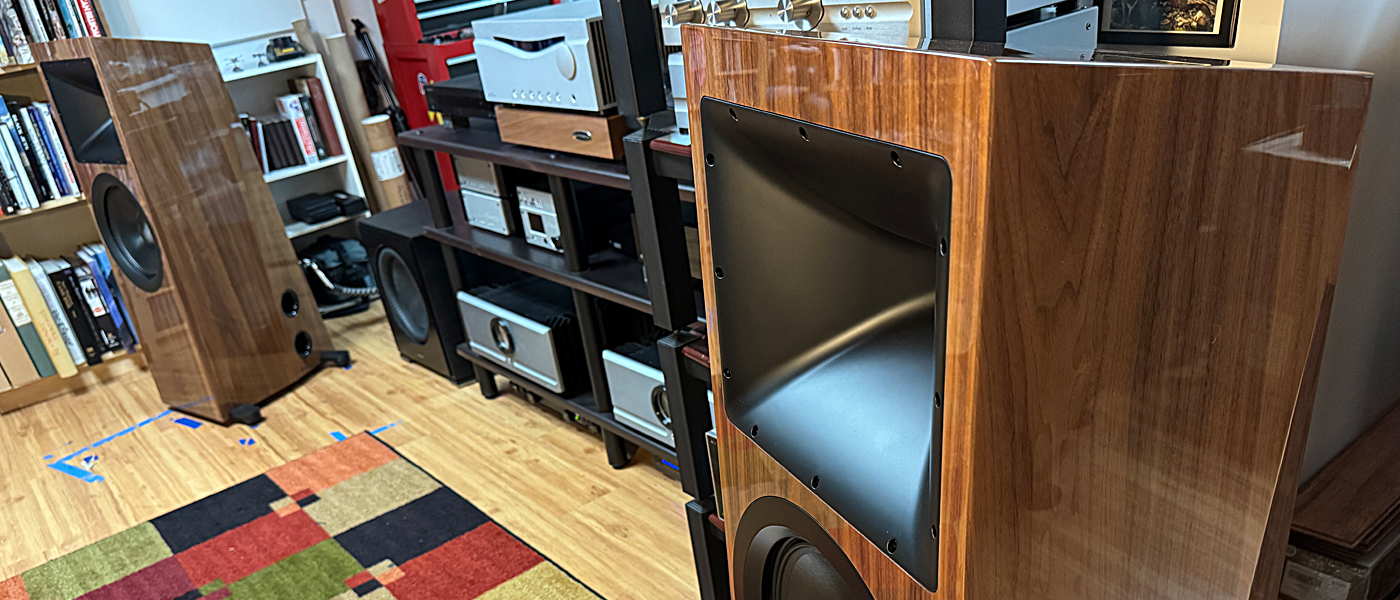
Usually, high-efficiency speakers with compression drivers, horn waveguides, and big woofers are the stuff of pro monitors, concert venue speakers, and sound reinforcement applications. With the Icon 12, Ø Audio takes the concept decidedly upscale with bespoke, custom-designed drivers and robust, beautifully finished enclosures. They are essentially a very large 2-way design, which claims to be very easy to drive with excellent dispersion characteristics due to that specially developed horn waveguide. In some respects, it reminded me of my time with the JBL 4367 floor-standers a few years back, but in many other ways, the Icon 12 are a very different animal.
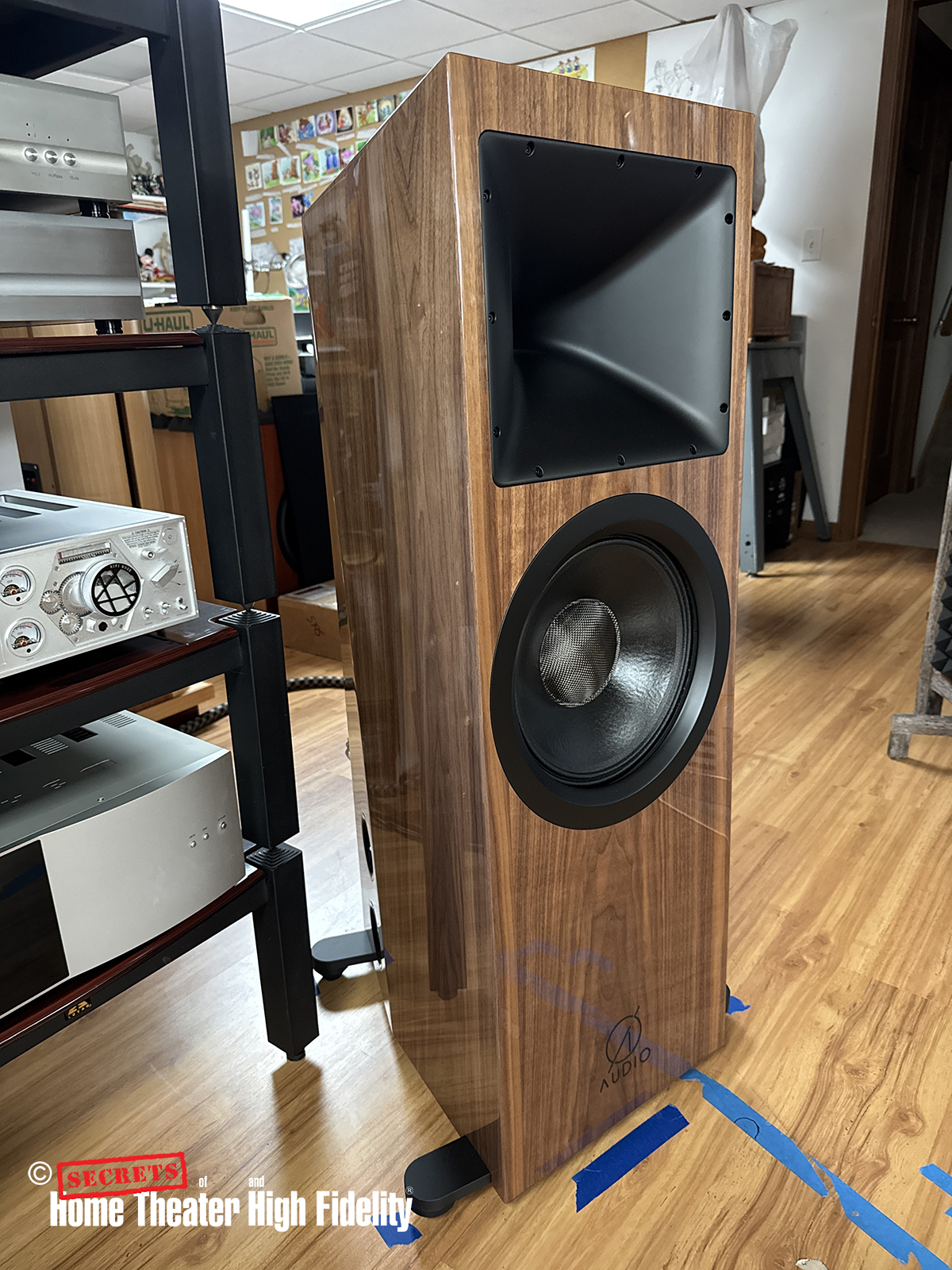
Ø Audio Icon 12 Floor-Standing Loudspeaker
- Very spacious presentation, notably cohesive from the bass through the midrange.
- They like to be played loud. Subjectively, the louder they got, the better they sounded.
- They are a very dynamic speaker. Vinyl playback sounded particularly good on the Icon 12.
- Tighter, almost point-source, style of sound delivery as opposed to what you hear from a multi-driver tower.
- Beautifully built, furniture-grade enclosures. Walnut finish is stunning.
Ø Audio may be a new name to many people, but this Norwegian audio brand has been out there for a fair few years and has only recently been making its presence known in the North American market. I first became aware of Ø Audio at the 2025 Munich High-End show, where I got to experience their similar, but larger, Verdande loudspeakers teamed up with a pair of their prototype Varg subwoofers. It was an impressive experience, and I got a chance to get to know the company co-founders, Sveinung Mala (who leads the loudspeaker engineering and acoustic development) and Jonathan Magnus Cook (who is responsible for international positioning, distribution strategy, and market execution), while attending the demonstration. It’s clear that there is some serious design and engineering work happening with their speaker designs. Philosophically, low distortion, wide dispersion, and high dynamic range (along with being “easy-ish” to drive) are the main goals with the Icon 12. The company has access to an anechoic chamber and a Klipple measurement system, along with longstanding relationships with advanced driver manufacturers to draw from. But both men also made the point in our discussions that while measurements are key, all final tuning is done by ear, and that they design their speakers to ultimately sound good in real living spaces. That’s the methodology they go by, and, judging from the recent buzz that Ø Audio has been getting, it may very well be working for them!
Design:
2-Way Bass Reflex Floor-standing Loudspeakers with dual side ports.
High Frequency Driver:
Single 3.4-inch Compression Driver with Carbon Fiber Diaphragm.
Horn Waveguide:
Quad Vertex – Constant Directivity Design.
Mid/Bass Driver:
Single 12-inch Ultra-Linear Long Stroke Extended Range Woofer.
Frequency Response (Manufacturer):
28 Hz – 20 kHz
Nominal Impedance:
8 Ohms
Sensitivity:
92 dB (2.83 V @ 1-meter full space)
Dimensions (H x W x D):
111 × 37 × 51 cm / 44 × 14.5 × 20 inches.
Net Weight:
121.3 pounds / 55 kgs
Accessories:
1 × Cleaning cloth, 2 × Magnetic front grille, 8 x Floor protection pads
Finishes:
Piano Walnut (Black grille)
Piano Black (Black grille)
Satin White (Black grille)
MSRP:
$25,000.00 pair
Website:
Company:
SECRETS Tags:
oaudio, icon12, horn, constant directivity, waveguide
Secrets Sponsor
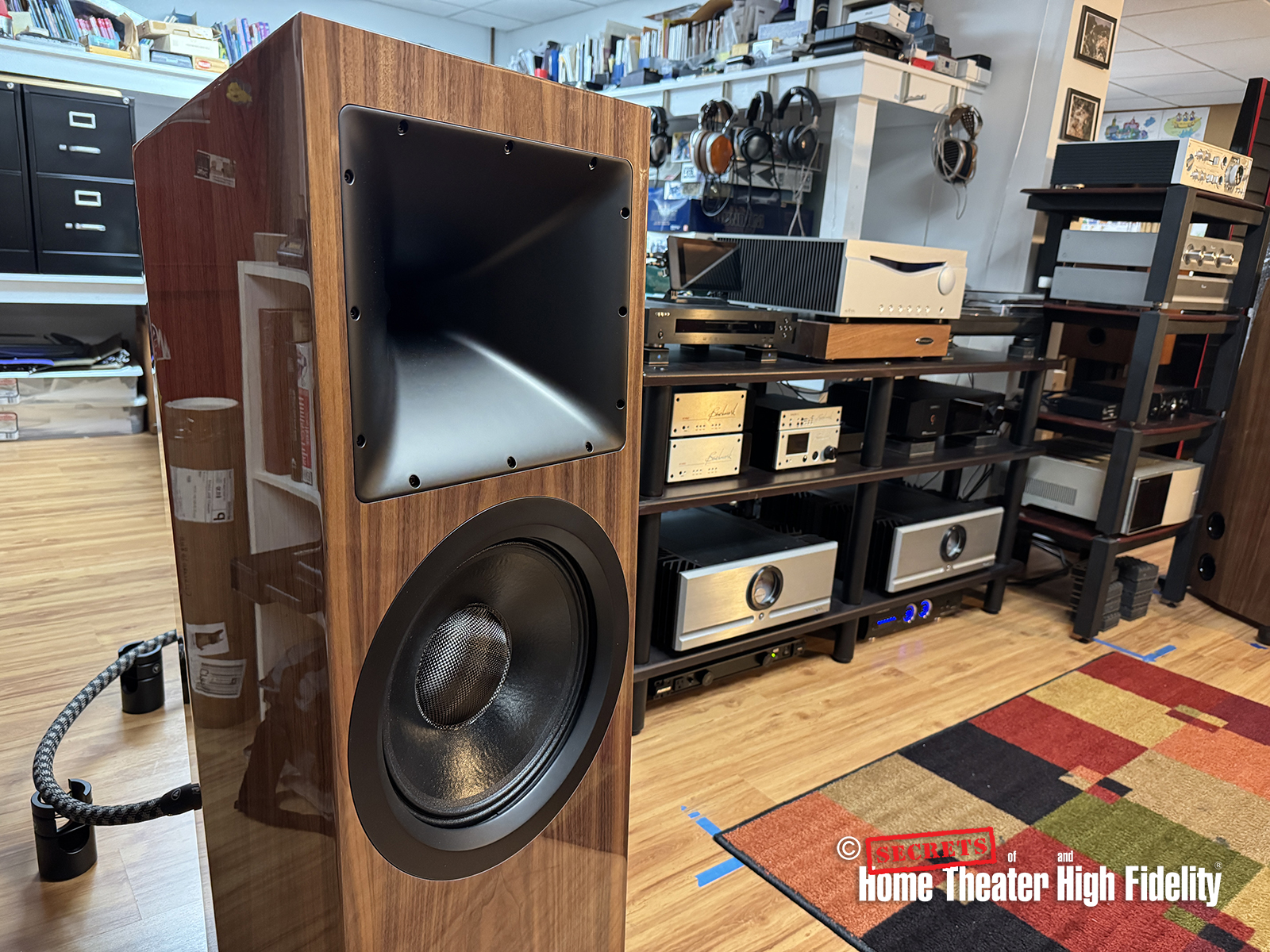
The Ø Audio Icon 12 has a very distinctive shape and stance. From the front view, they look like a standard rectangular column.
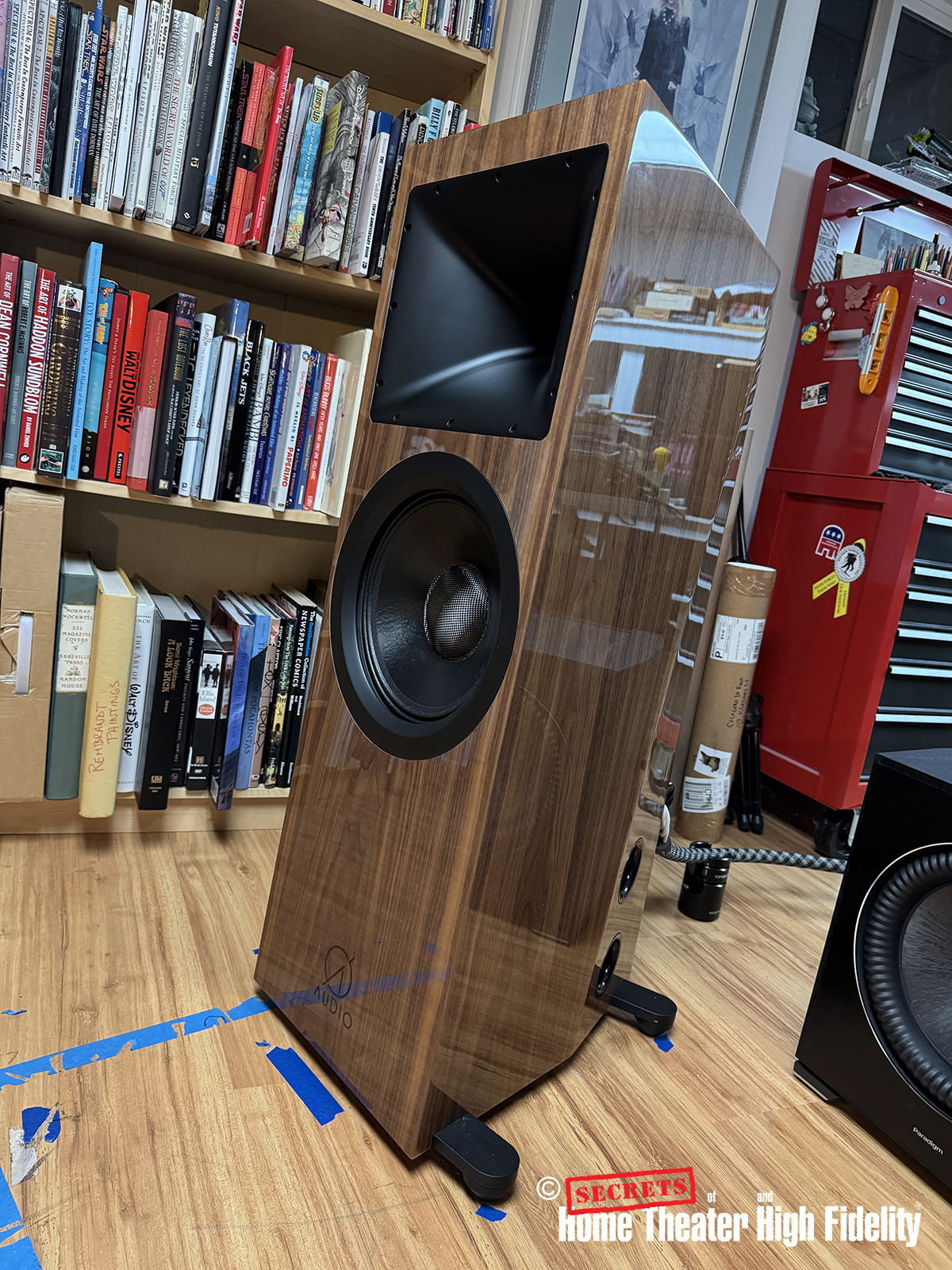
But as your eye moves to the sides, the speakers are not only beveled with two distinct planes, they are also angled, along with the much narrower rear baffle. Add in the speaker’s angled top side, and it results in an overall shape that looks solid with an impressive stance.
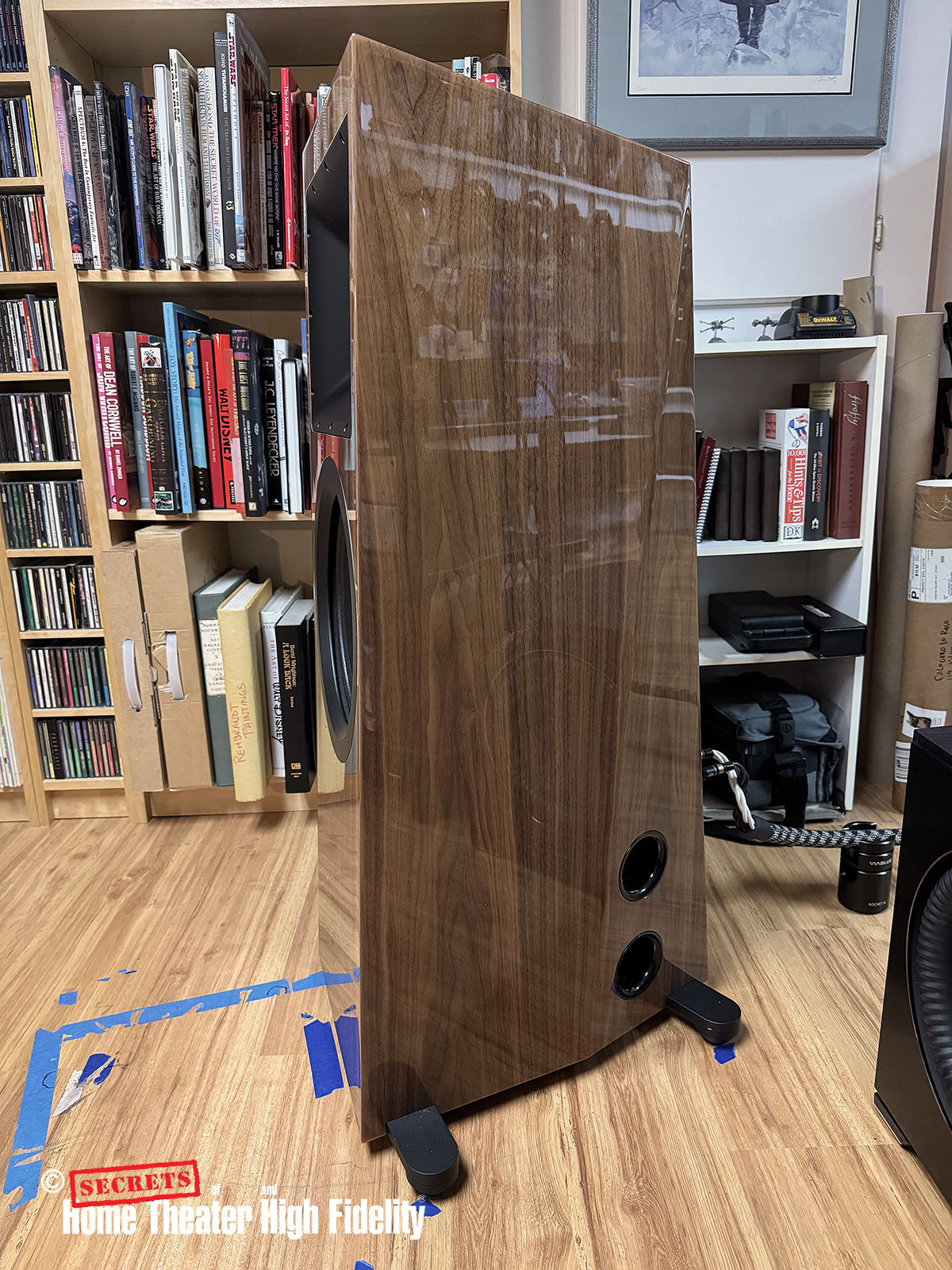
Someone was clearly thinking about avoiding parallel surfaces (and controlling internal standing waves) with this design. The speaker’s profile also reveals how the front baffle is canted back a few degrees, angling the driver output slightly upward. At first glance, you’d be forgiven for thinking that the Icon 12 looks like statuary or modest monuments. While not exactly Norse, the statues on Easter Island come to mind every time I look at these beauties.
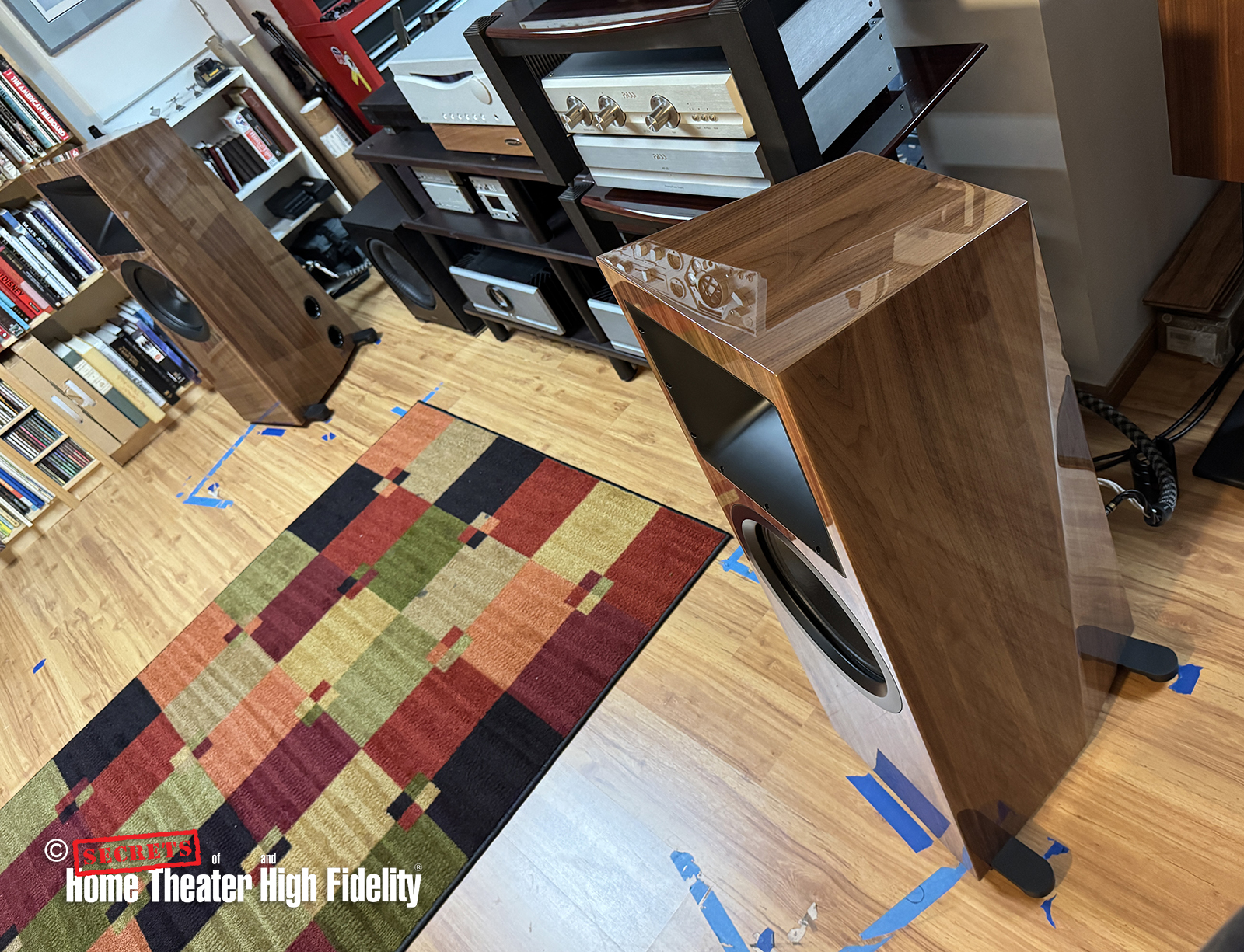
And beauties they certainly are in the very fetching piano walnut finish that the review samples were sporting. And yes, while not the absolute heaviest speaker that I’ve had to wrangle, the Icon 12 feels as solid as it looks. Being constructed from high-grade composite paneling, firmly knocking on every surface gave me no reverberant sounds for my knuckle’s troubles, just well-damped, muted “thuds.” The four stubby metal outrigger feet at the base are substantial and have integrated non-skid pads at their bottoms, so hardwood and other solid flooring will be fine. All told, the odds of the speakers being knocked over by anything other than a hard-charging defensive tackle are pretty much nonexistent.
Each speaker has two ports mounted low and on the side. One speaker has them on the left side, and the other on the right. Depending on your room, you can experiment with the ports either facing inwards or outwards to achieve the best-sounding bass response. Ø Audio does recommend starting with them facing in, as that seems to give the most consistently preferred response. The “Norsemen” do include a pair of foam bungs with each speaker, so one can further tailor the bass to one’s liking.
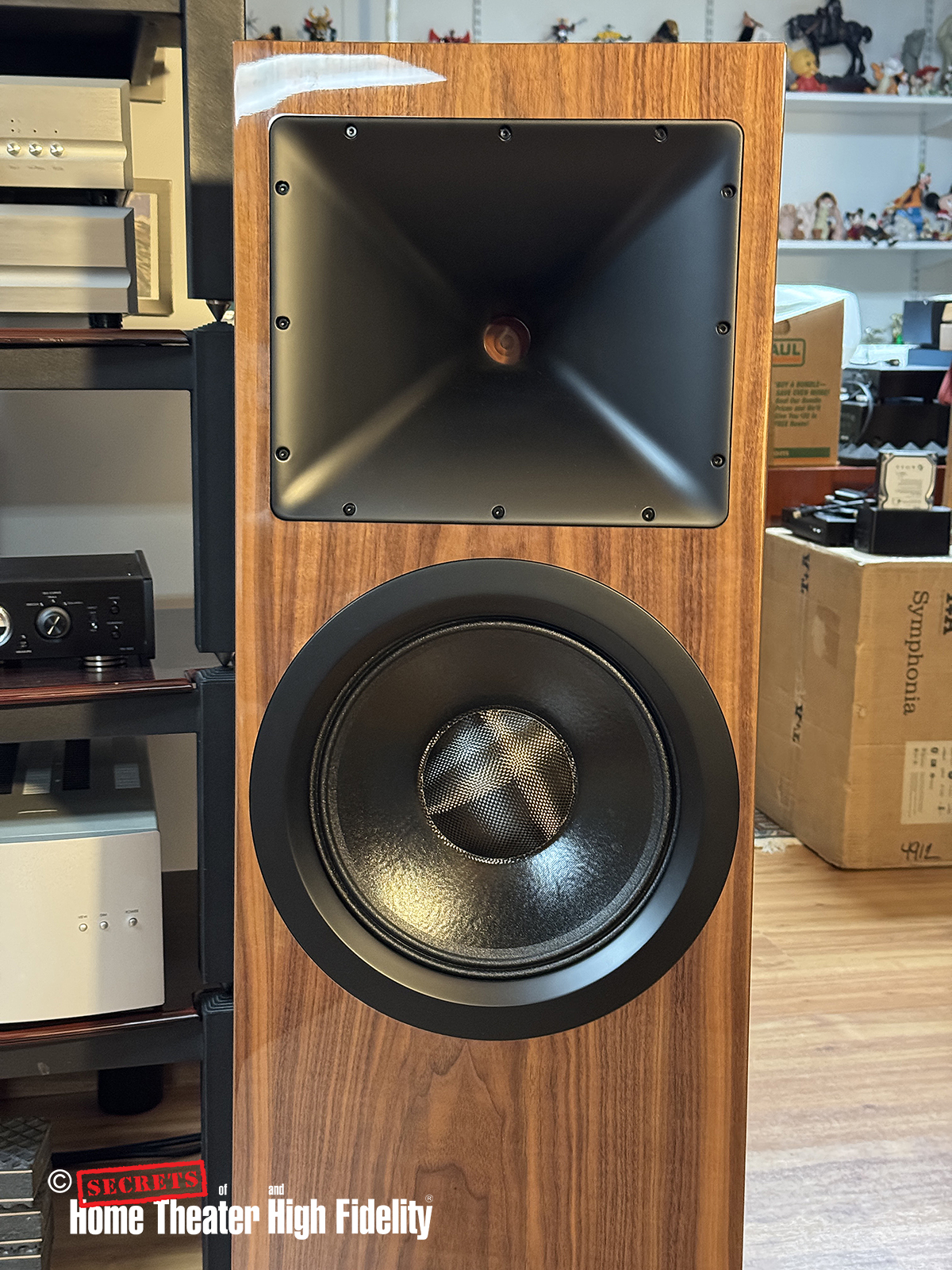
On the driver side of things, the speaker is a two-way design that starts with a substantial 3.4-inch compression driver mated to a horn waveguide to handle high-frequency duty. A couple of unique points about this driver/waveguide combo are that the compression driver itself uses thin-ply carbon fiber for its diaphragm versus Titanium, Beryllium, or Phenolic types. The claimed benefits are increased sensitivity due to the lighter weight of the material, excellent rigidity to help minimize distortion, and a higher thermal tolerance so the driver can be pushed and still perform well.
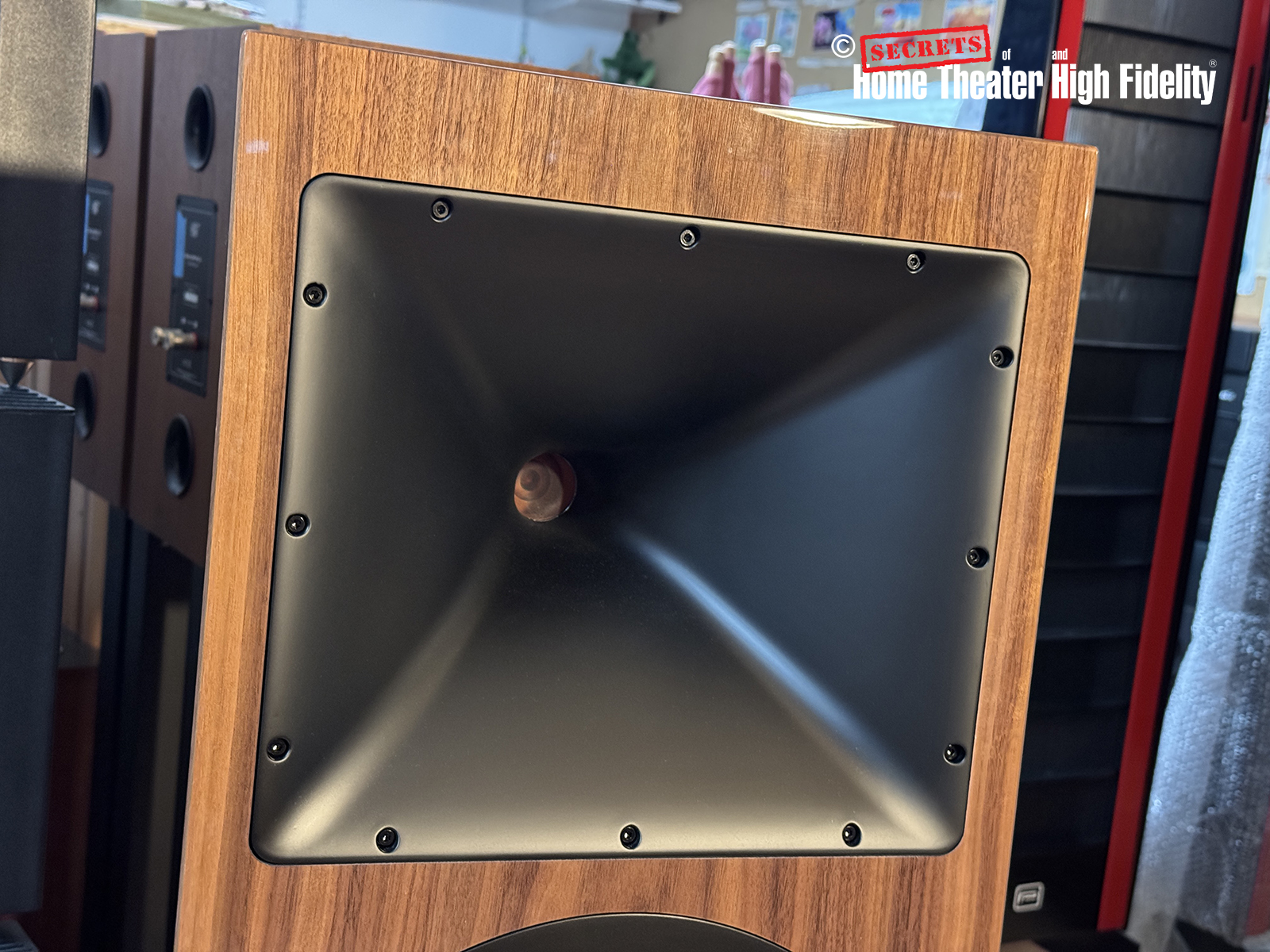
The waveguide, which Ø Audio incorporates what they call “Quad Vertex Soundfield Technology,” is specially designed for constant directivity and optimizes the dispersion characteristics of the compression driver so that its sound mates up as well as possible with the dispersion of the woofer at the crossover point. It is also said to be less susceptible to the “cupping” sound associated with some other horn designs.
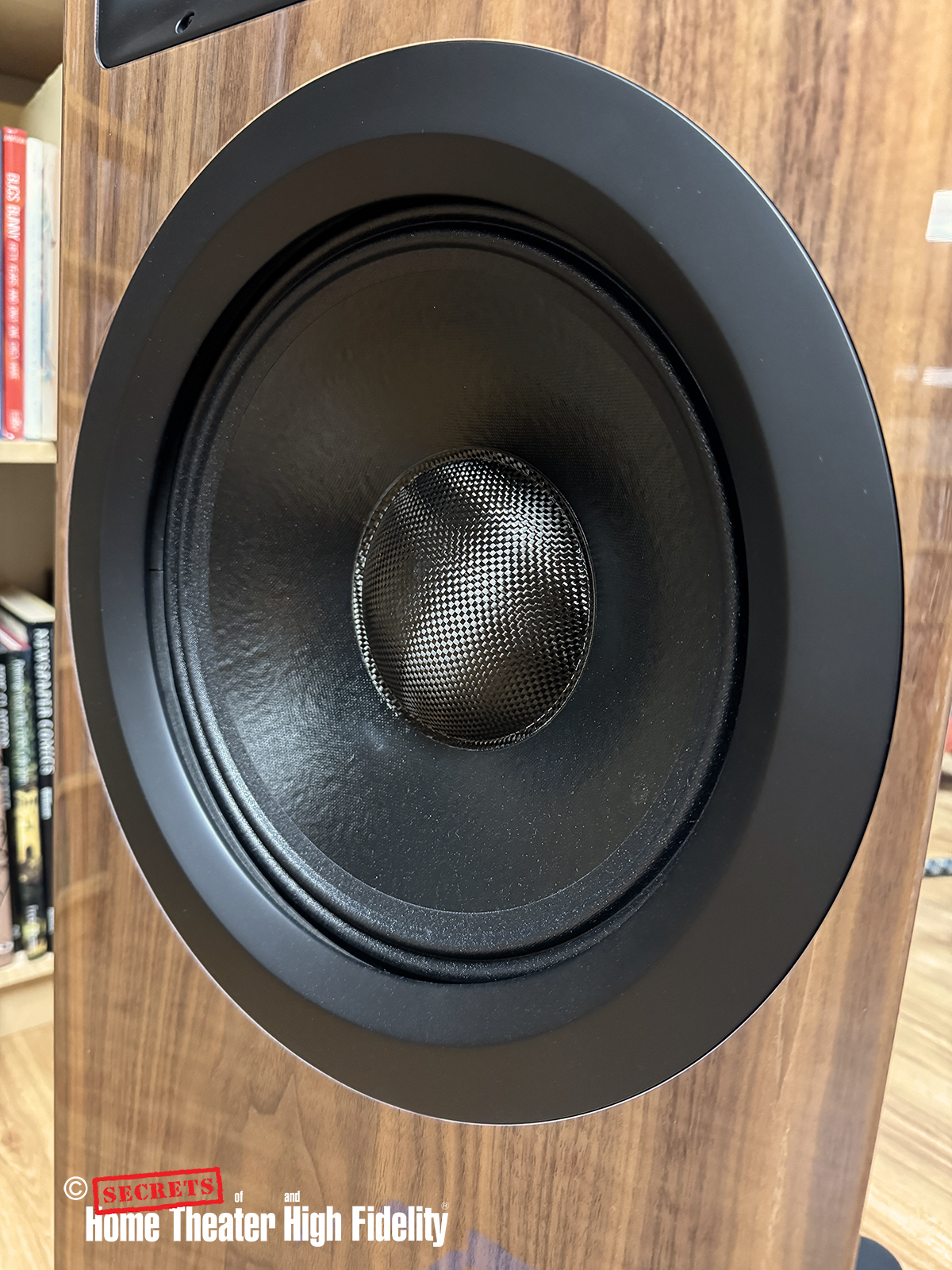
The woofer in the Icon 12 is an in-house-designed 12-inch ultra-linear driver capable of a good deal of throw, while still maintaining a linear response and low distortion levels. The driver uses a specially damped paper cone with a carbon fiber dust cap.
Both drivers are custom-manufactured by a trusted OEM partner to Ø Audio’s precise specifications.
There is a first-order crossover network with a minimum number of components integrating the two drivers.
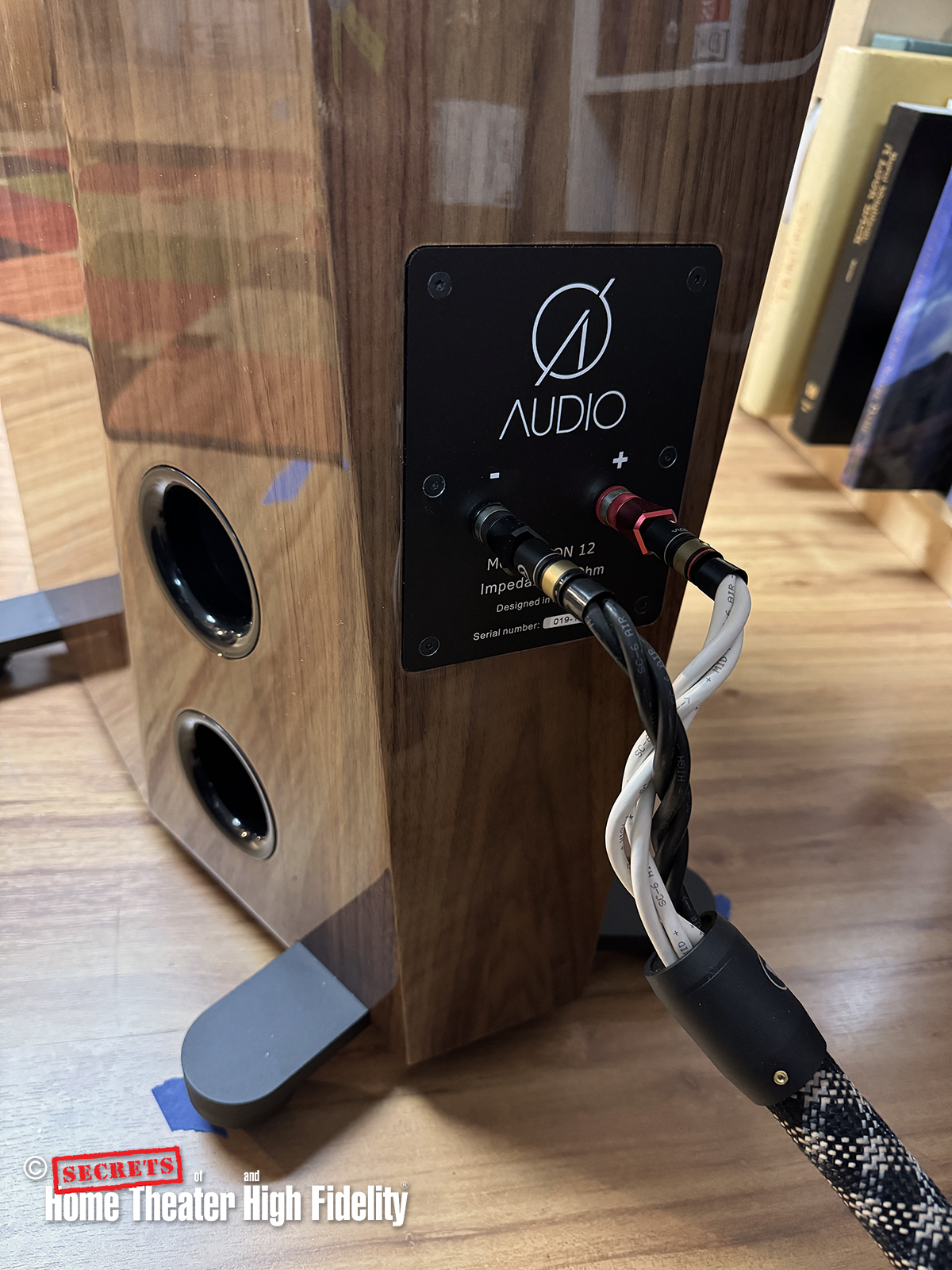
On the back panel, there is just a single pair of high-quality binding posts on each speaker, so hookup is easy and uneventful. Besides the Piano Walnut finish I have, the Icon 12 is also available in a Piano Black and a Satin White finish. The quality of the finish on the review samples is utterly flawless and speaks highly of the manufacturing talent involved here.
With a claimed Nominal Impedance of 8-Ohms and a sensitivity of 92 dB, the Icon 12 should be able to be driven easily and to high volume levels. In our discussions, Jonathan Cook reiterated that these speakers like to be driven loud, so I was curious to put that confident statement of his to the test.
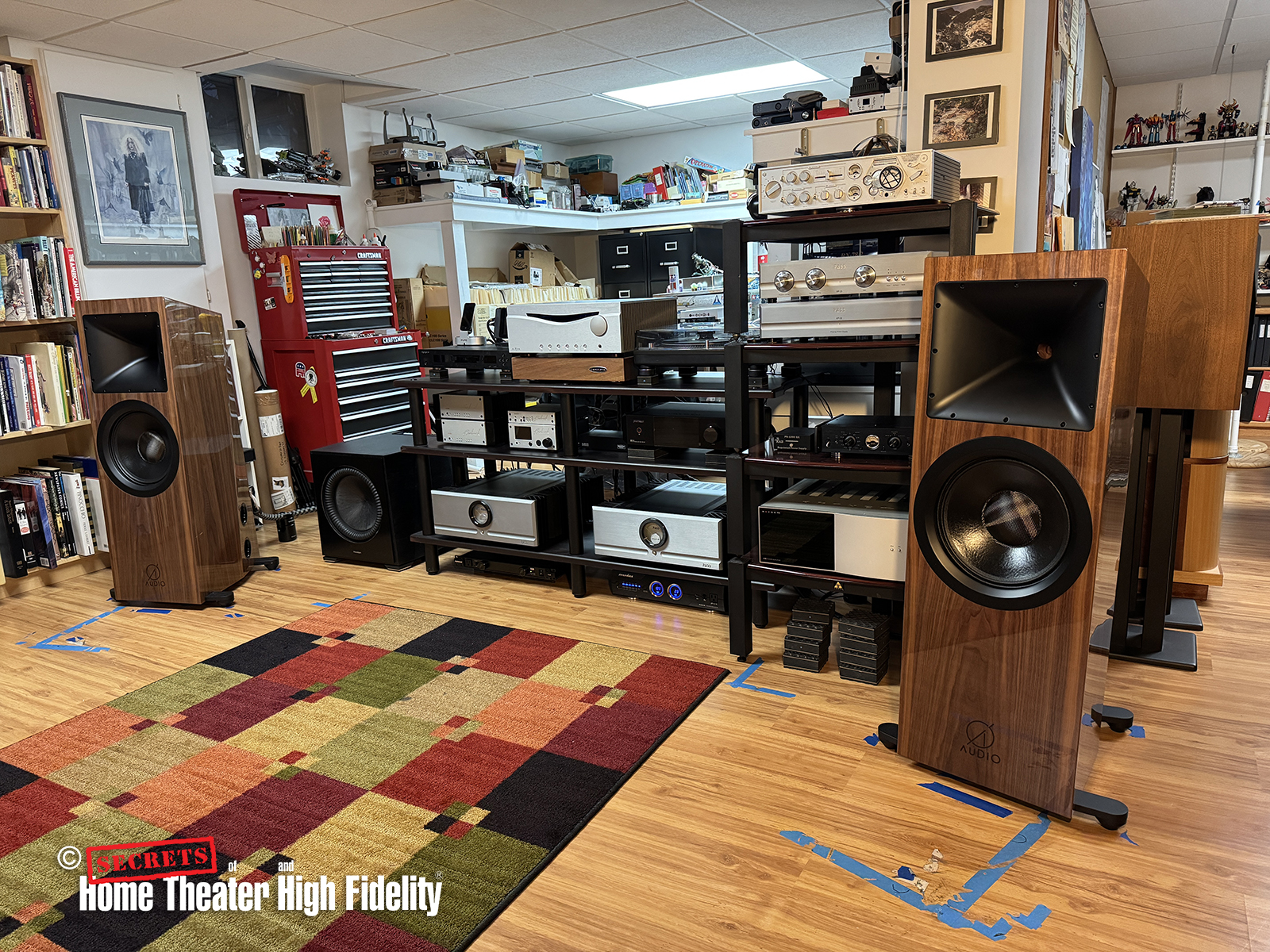
Once I got these bad boys down the stairs and unboxed, I began to play around with positioning. After a bit of time, I settled on the Ø Audio Icon 12 speakers positioned almost 10 feet apart and toed-in to where the tweeter axis converged about a foot behind my head. My listening position was just over 11 feet away from the center point between the speakers. I also settled on the speaker bass ports pointing inward, as that seemed to give a more linear bass response over the ports facing outwards. Overall, I felt that this positioning worked best with the dispersion characteristics of the Icon 12 to give me the best combination of overall soundstage, bass, and image detail.
The associated equipment in the review included:
– Two Pass Labs XA-60.8 Monoblock Power Amplifiers.
– Two Benchmark AHB2 Power Amplifiers.
– Benchmark DAC3 B Digital to Analog Converter.
– Benchmark HPA4 Preamplifier.
– Eversolo DMP-A10 Preamplifier
– Accuphase E-700 Integrated Amplifier.
– OPPO BDP-105D Universal Disc Player.
– GeerFab D.BOB Digital Breakout Box.
– DIY Raspberry Pi-based Endpoint.
– Technics SL1200 Mk6 Turntable modified by KAB Electroacoustics.
– Audio-Technica ART20 MC Phono Cartridge.
– TEAC PE-505 Fully Balanced Phono Preamp.
– VIABLUE Interconnects and speaker cables.
– EVP Vibration Protectors from AV RoomService.
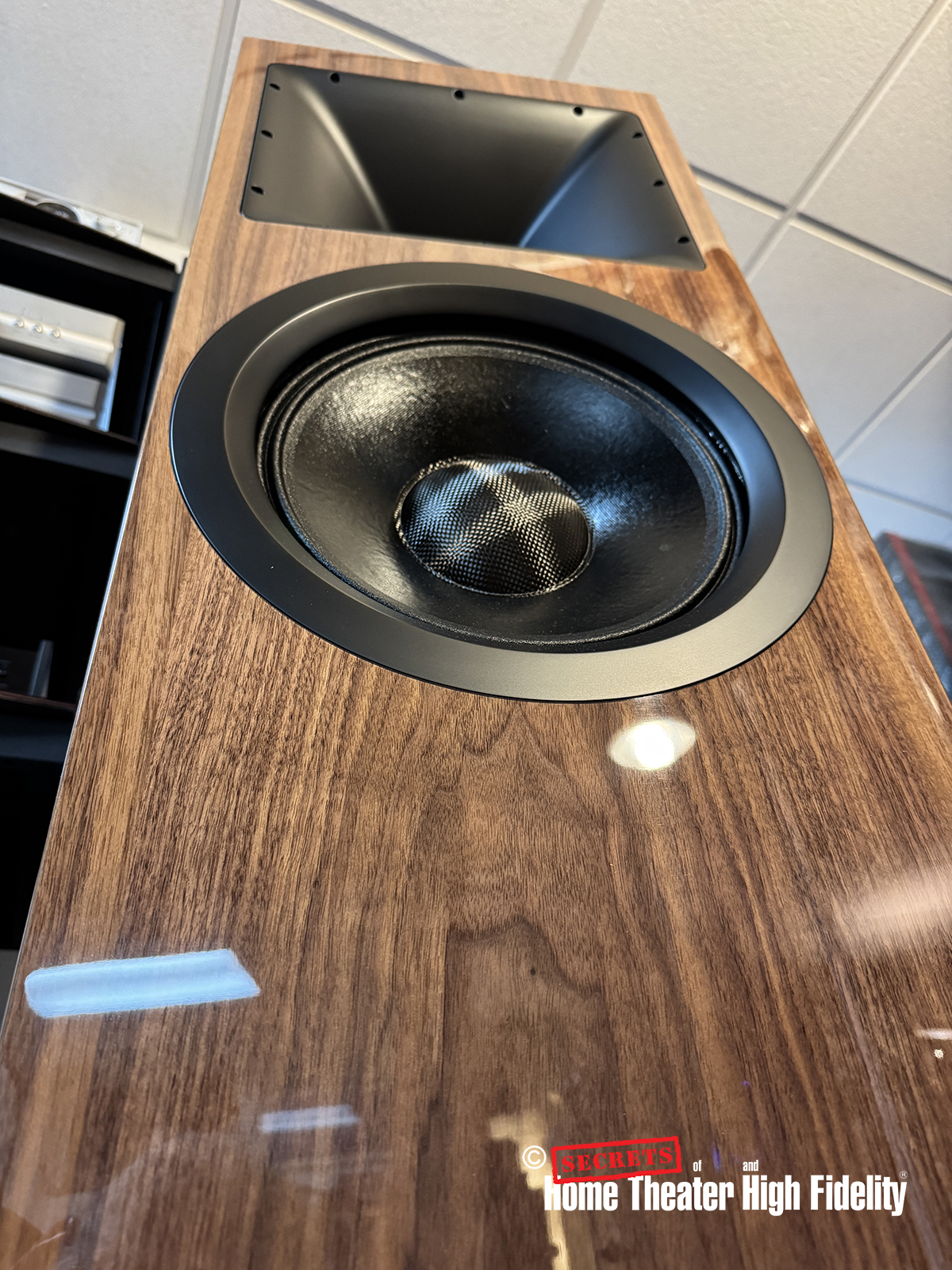
In many ways, listening to the Ø Audio Icon 12 was like listening to a pair of 2-way bookshelf speakers, but on steroids. I mean that the music sounded like it was coming from a more focused point of origin as opposed to what I experience when listening to a more traditional multi-way tower speaker. It’s not quite as focused as when you are listening to a well-designed coaxial (or concentric) speaker design, but I found the experience to be similar.
The scale of the sound, on the other hand, is a whole other animal. The Ø Audio Icon 12 sounds big. Very big! They project a very wide soundstage that sounds very uniform from top to bottom. There is also a bit of perceived warmth to the sound in the upper bass to lower midrange. Not so much that it overshadows vocal or instrument clarity and sparkle in the midrange and treble areas, but there is enough that it works to make the speakers sound “bigger” or impart more of a sense of immersion than might otherwise be the case. And as the volume gets louder, that sense of image width and immersion does indeed scale accordingly.
I also observed that while the soundstage was wide and the positioning of performers and instruments was detailed and accurate (in both depth and width), I found that if I stood up or wasn’t sitting at the right height, the tonality of the speaker tended to change noticeably. I could be listening off-axis, and the results were still great, but being seated at the right height seemed to be more important with the Icon 12.
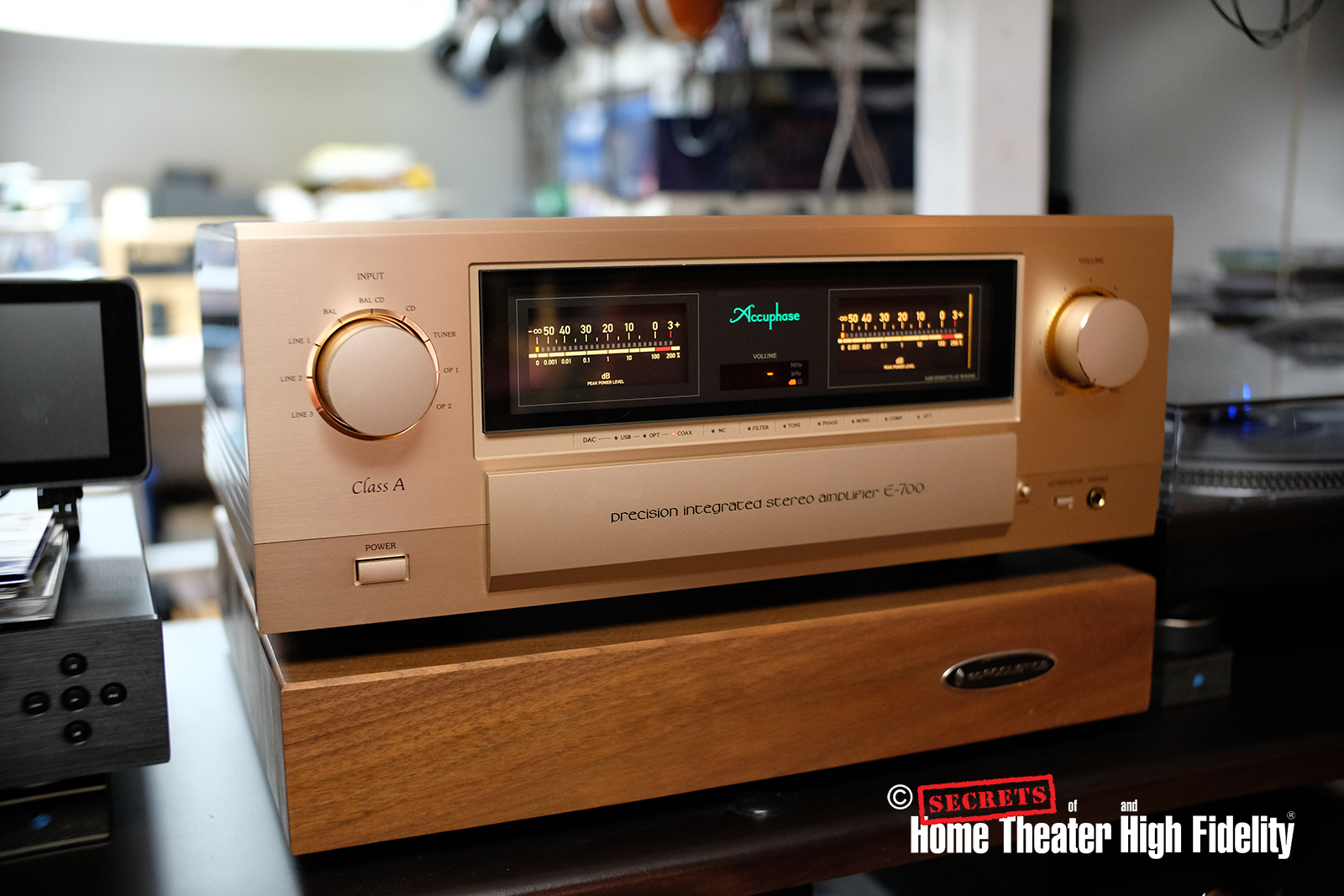
It also didn’t seem to take much power to drive the Icon 12 to decent volumes either. The Accuphase E-700 integrated amp that I had on hand, with only 35 watts Class-A power (into 8 ohms), had no issues getting these speakers to sing very sweetly. I expect a high-quality tube amplifier should work rather well with the Icon 12 if an owner wanted to experiment with such a pairing.
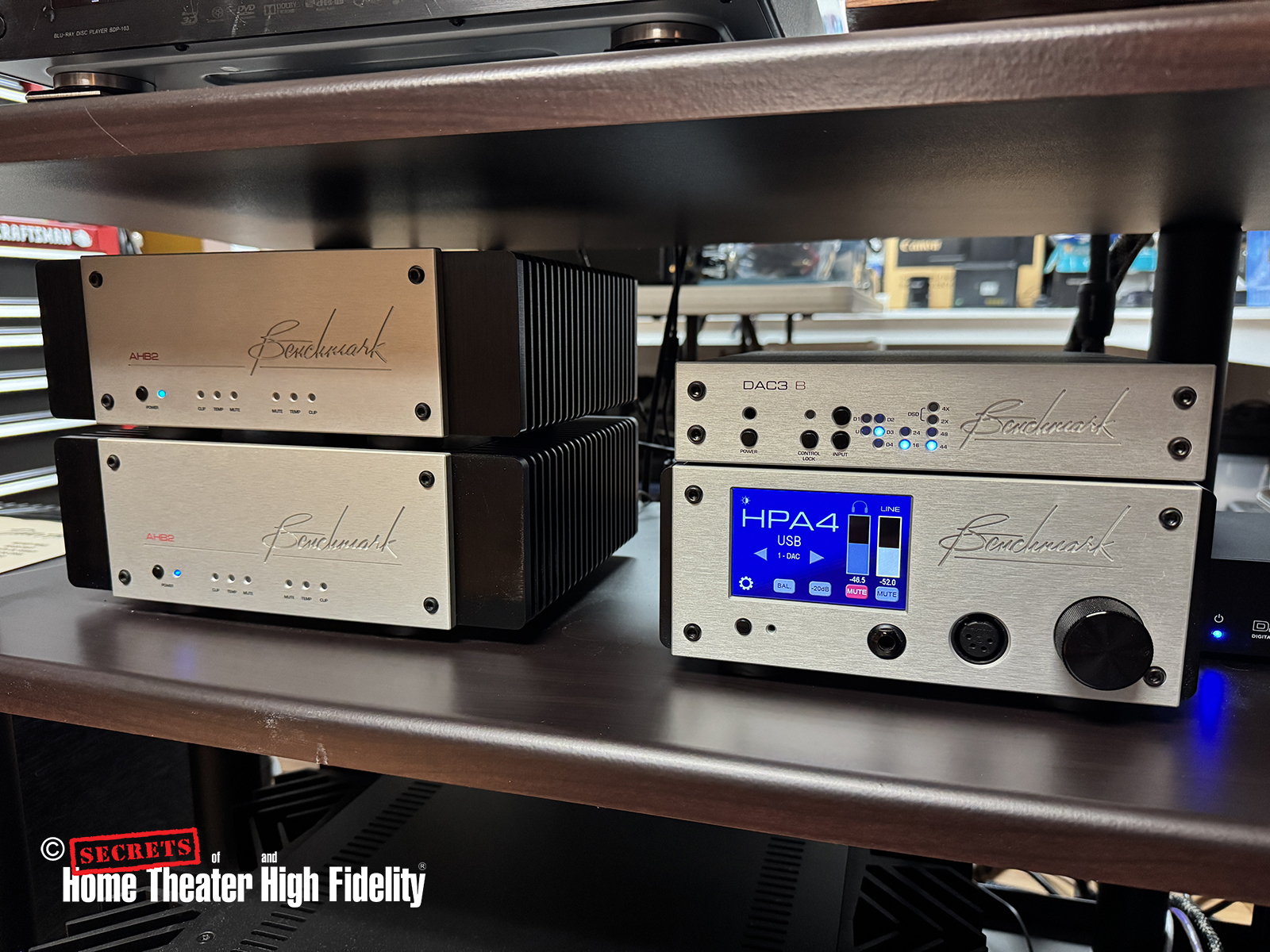
Needless to say, the Pass Labs XA 60.8 power amps and the Benchmark Media System stack I have as part of my reference system had zero problems driving the Icon 12 speakers. These were the core components I ended up using the most in this review.
While physical CDs and streaming make up the bulk of my listening habits, for whatever reason, there are some speakers that I find are particularly suited for vinyl playback. Much like the JBL 4367 that I referenced earlier, the Ø Audio Icon 12 seemed to give me a little extra pleasure when spinning my 33s and 45s. If I had to hazard a guess as to why that is, I would say it’s a combination of that hint of warmth to the sound, along with being easy to drive, and then there’s the sheer dynamic capacity of these speakers. It all worked well together, and I kept finding myself reaching for my record shelves more often with the Icon 12 than is normally the case.
Even though the Ø Audio Icon 12 uses a 12-inch mid-bass driver, the speakers didn’t produce what I’d consider prodigious quantities of bass in my large studio space. At least not to the degree one would assume given their size. To be fair, the speakers were placed well away from the back wall, so there was not that expected reinforcement from the room. But I have had smaller or skinnier towers in the same placement that have delivered a higher perceived level of bass. In general, the bass performance of the Icon 12 sounded solid, linear, and had good extension. And I’m sure in a more traditional room with symmetrical placement closer side and rear walls, the room loading would have given me plenty of additional low-end punch to enjoy. But we all have to deal with the room that we have, and mine can be a challenge with certain speaker designs when it comes to bass reproduction.
So, the next question became: how well do these speakers pair up with a subwoofer? I soon discovered that the answer was pretty darn well! I currently have a Paradigm XR13 in-house for review. Using the bass management resources of the Eversolo DMP-A10, I was able to achieve a fairly seamless blend in my room using a 100 Hz crossover point. The dynamics, extension, and raw sound quality of the Paradigm XR13 subwoofer proved to be the perfect foil for the Icon 12, resulting in a speaker combination that truly delivers the sonic goods from top to bottom. Clean, detailed, and frankly slamming deep bass perfectly blended with the speaker’s point source imaging and huge soundstage. It connected the dots in my mind for what Ø Audio may be working towards with the development of their Varg subwoofer and how it might be used with their speakers. As I said, in a more traditional listening setup, it is unlikely you will ever need a subwoofer with these speakers. But as is so often the case in our “little hobby,” when does need have anything to do with it?
Mono Listening:
The whole “more point-source” sound presentation of the Icon 12 was intriguing to me, so besides my regular music listening notes that you’ll read shortly, I also decided to do a little listening test using some mono music files that I have. I positioned one of the Ø Audio Icon 12 speakers next to one of my Revel F228Be speakers that I used for comparison.
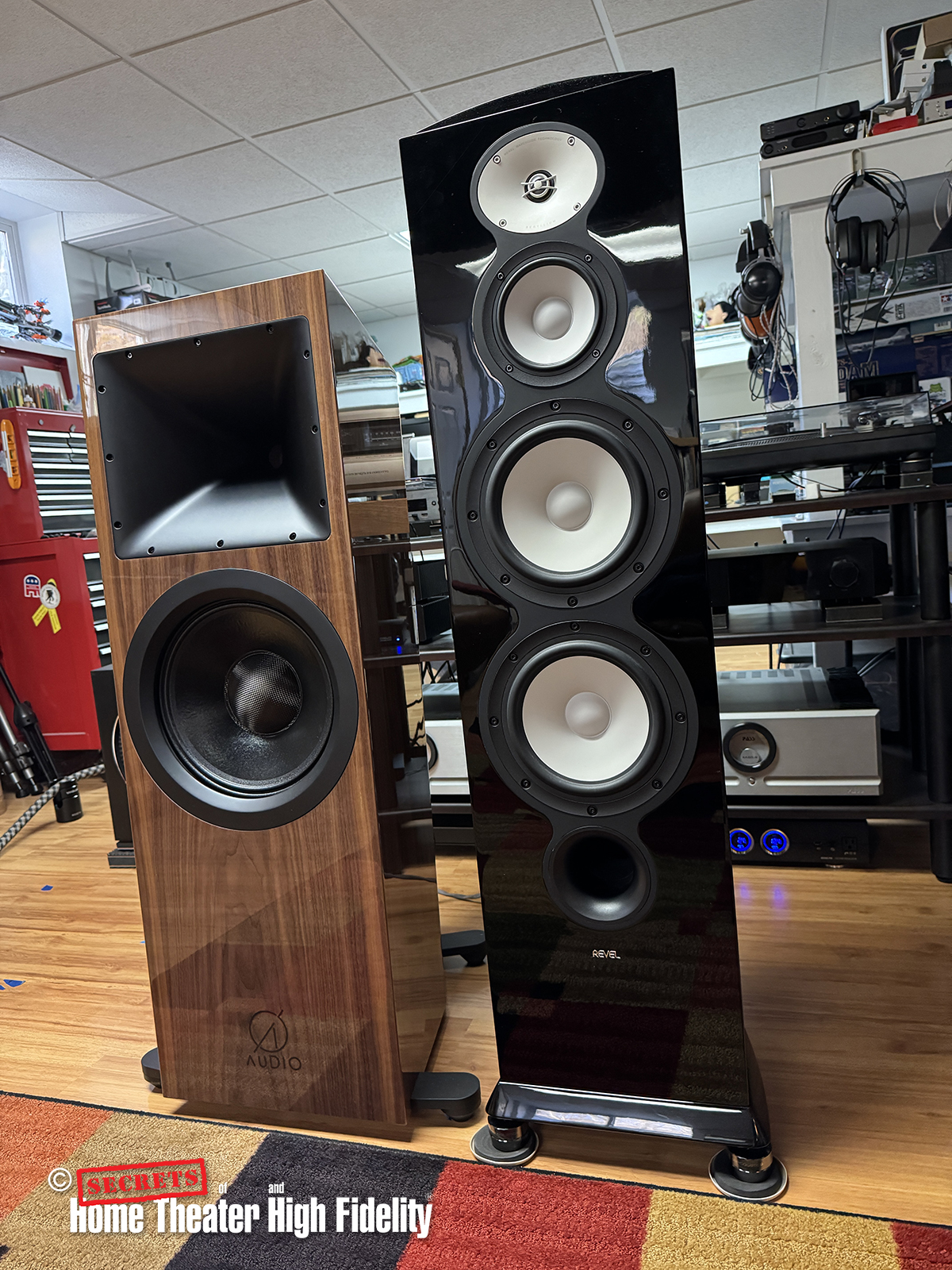
Each was wired up to a separate amp channel and preamp input, then level-matched so that I could easily switch between the speakers on the fly via remote control. Each of the six tracks that I used consisted of one-minute music segments that repeat several times so that differences can be more easily determined when switching between the speakers.
These tracks are all mentioned in various Harman AES papers. About three per paper.
They are picked since they are shown to be the most revealing in Harman’s testing using trained listeners.
David Rich, who prepared each of the clips for me, notes that all of them have a pink noise-like spectra. Pink noise is known to be the most revealing of sources for spectral errors, but with these clips, you get music that is more fun to listen to than straight pink noise.
The tracks I used were:
– Battlestar Galactica, the main title theme (sweeping orchestral).
– Cool This Fire (Female vocal, modern pop).
– Tracy Chapman, Fast Car Live (live, intimate acoustic with vocals).
– How Long Has This Been Going On (Male vocal, Jazz).
– Steely Dan, Cousin Dupree (Male vocal, Jazz/Rock).
– Trittico (sweeping orchestral).
Listening to speakers in mono is a very revealing experience, as it focuses attention on the way a single speaker delivers its sound without relying on the construct of the stereo image. And being able to switch between two different speakers on the fly highlights what the intrinsic speaker design differences bring to the table.
The big orchestral scores quickly displayed how the sound was originating from the center of the Icon 12 and how it projected out more widely, where the Revels had a taller, narrower presentation. The bass output of both speakers was essentially identical. The Revel also allowed me to hear details more easily in these complex scores, where the Icon 12 sounded softer and fuller. Instrument details seemed to sound farther back as opposed to being “front and center.”
When it came to female vocals, such as on “Fast Car” and “Cool This Fire,” the Revels presented them in a more upfront manner, albeit with a leaner sound. Vocals also sounded like they were coming from a higher spot on the speaker. The Ø Audio Icon 12 had more fullness to the respective singer’s voices, and they sounded like they were coming at me from ear level, but they were placed a bit farther back in space. Still clear sounding, but the vocals didn’t seem to “pop” by comparison. Still, I preferred the Icon 12 speaker’s take on “Fast Car” in particular, perhaps because it was the live version of the song, but it added some extra weight and body to the pretty sparse acoustic rendition.
“Cousin Dupree” and “How Long Has This Been Going On” are more layered tracks featuring male vocals, and I felt that the Revel speaker allowed me to dissect the details of everything that was going on in those tracks a little bit easier. Although the Icon 12 speaker’s smoother and fuller take on these two tracks was very appealing. The more centralized point-source origin of the sound made these two tracks feel a bit more cohesive, if perhaps not quite as detailed. Again, the dispersion of sound from the Revel speaker was much narrower and taller. The tweeter and midrange placement also made the vocals feel like they were coming from over my head compared to the Icon 12.
Secrets Sponsor
Stereo Listening:
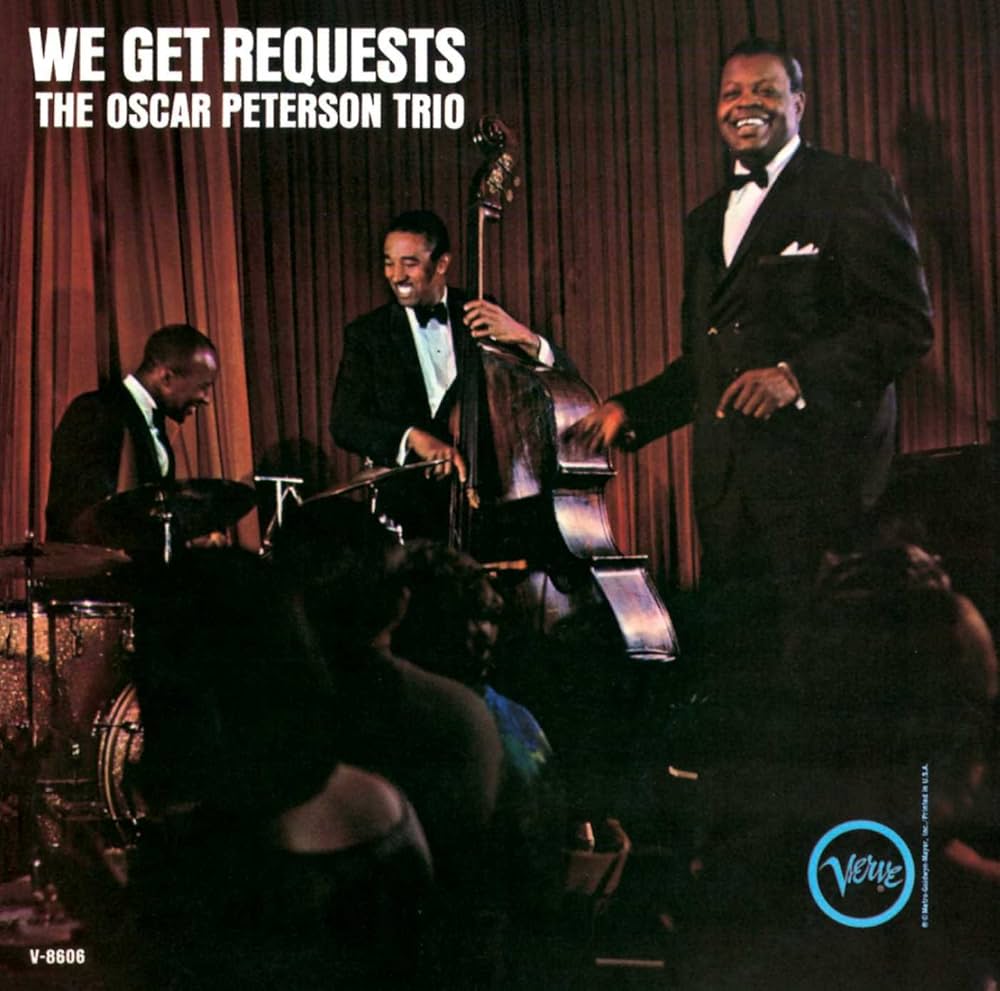
The Oscar Peterson Trio, “We Get Requests”
Now, listening to the pair of Icon 12 speakers properly placed and in stereo, as the universe intended (no sub), I pulled up “You Look Good to Me” by The Oscar Peterson Trio from the We Get Requests album via Qobuz. Instruments had a great sense of separation and were precisely placed in the mix. Brush work on the skins sounded plenty detailed, and cymbals were nicely brassy-sounding and clear. Peterson’s piano had a fantastic sense of clarity and ring to it, along with being able to hear his mumbled scatting in the background. The plucked acoustic bass was also tight and punchy with no overhanging notes to speak of, and when Ray Brown used the bow on it, the distinctive woody reverberation of his bass sounded so good. I proceeded to play the whole album and found myself turning up the volume a few times. The Ø Audio Icon 12 put me right in the thick of the music and did not strain in the slightest.

Alexandra Whittingham, “Letters from Paris”
While on Qobuz, I also called up Alexandra Whittingham’s Letters from Paris album, which features beautiful solo acoustic guitar supported on a few tracks with a string ensemble and cello. The Icon 12 speakers were superb at relaying the details and delicacy of her guitar playing, along with that of the supporting strings. The sound of the cello has the expected weight and impact, with the details of the bowed strings being translated nicely. The speakers sounded very spacious and almost immersive on this material, with the soundstage being so wide and deep. Guitar string harmonics had a lovely ring and decay to their sound. One might see the horn waveguide on these speakers and assume that the sound could be overly detailed and fatiguing, but that is not the case at all. The smoothness and subtle warmth of these Ø Audio speakers were very suited to this material.
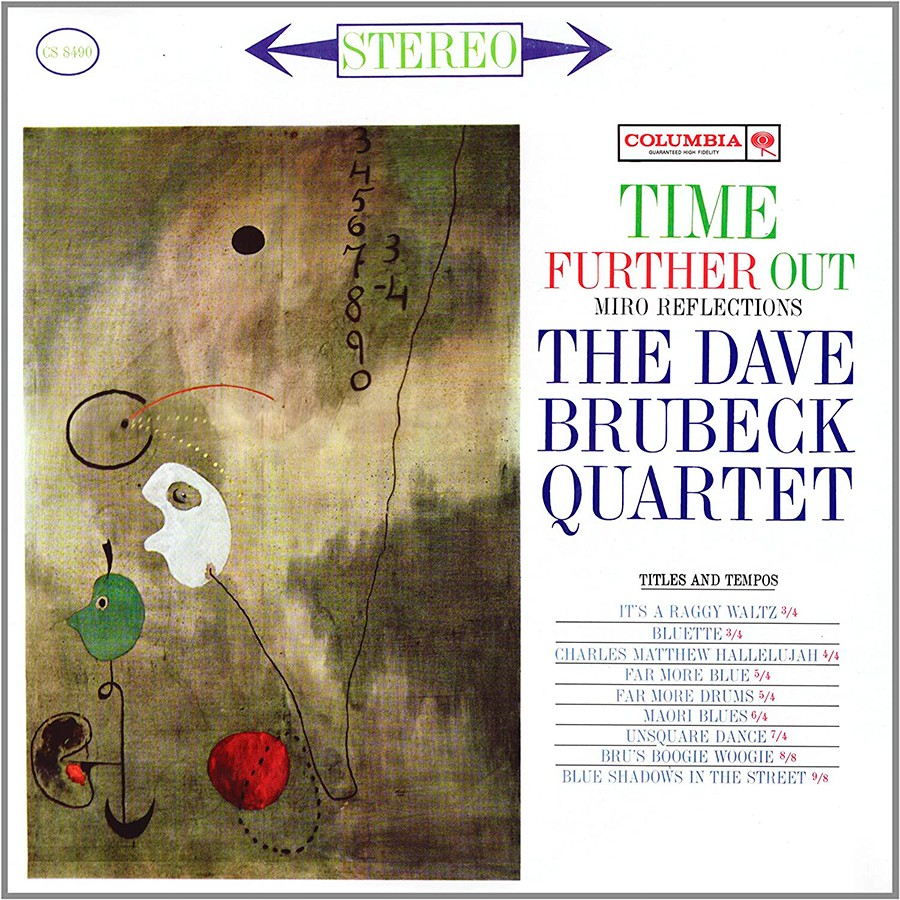
The Dave Brubeck Quartet, “Time Further Out”
Switching to some vinyl, I began spinning the Dave Brubeck Quartet’s “Time Further Out!” and it just sounded superb! I felt like I was hearing much more body in the lower midrange than I am used to on this album. Paul Desmond’s alto saxophone sounded right there with an almost smoky and immediate character on the track “Bluette.” Brubeck’s piano and Eugene Wright’s bass had more substance and weight to their sound than when listening on some more traditional speakers that I’ve had in this room. Joe Morello’s brush work on the drums and cymbals was so smooth-sounding but had just enough detail to not come across as dull or muffled. Speaking of drums, Morello’s solo on the track “Far More Drums” just sounded outstanding. The Icon 12 excelled at delivering the dynamics and impact of the full drum kit as all the strikes on the skins, cymbals, and kick drum alternated and travelled across left and right. Overall, the music on this record just seemed to have more life and punch to it with these speakers.
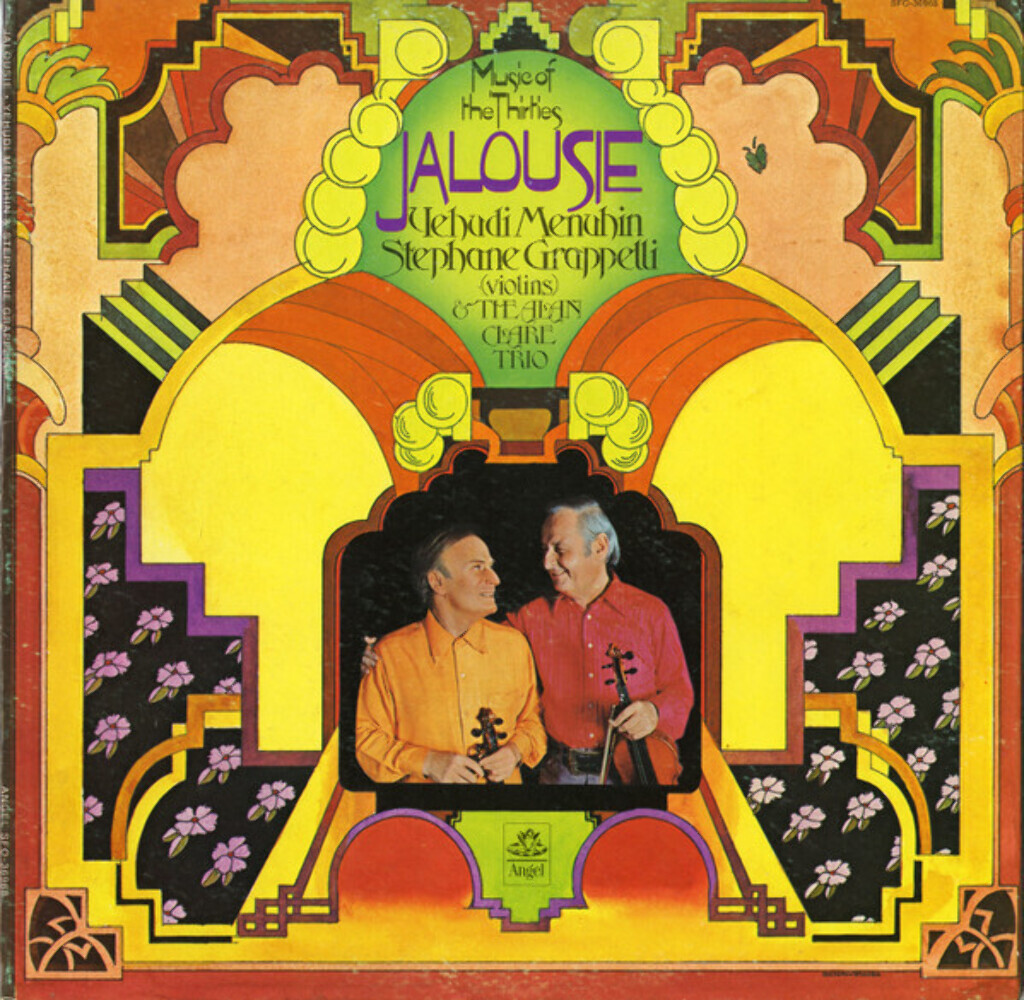
Yehudi Menuhin, Stephane Grappelli & The Alan Clare Trio, “Jalousie – Music Of The Thirties”
A similar experience was to be had with the LP “Music of the Thirties Jalousie,” featuring Yehudi Menuhin and Stephane Grappelli with the Alan Clare Trio. The two master violinists sounded especially dynamic and dimensional. Their playing was reproduced with a melodic sweetness, even at the most piercing notes, without a trace of abrasion at higher volumes. On the track “The Lady is a Tramp,” the natural wooden resonance from their respective instruments was easily and convincingly conveyed while the speakers imaged each soloist precisely, one between the center and left speaker and the other between the center and right speaker. When both Menuhin and Grappelli soloed together, each performer was clearly delineated by the Icon 12, and no details from either were obscured. The acoustic bass playing was satisfyingly full and solid, and the drums and piano also had a great sense of dimension and detail. While the solo violins were the stars of this LP, the Icon 12 seemed to capture other fine details in the music as well, like the metallic cymbal strikes in the background, rendering them properly in space. And speaking of space, these speakers threw an expansive image from this album that extended well beyond the speaker boundaries. There was also a noticeable and very appealing sense of depth with this music that didn’t come across as something artificial or unnatural. Again, these Ø Audio speakers really seemed to light up as the volume edged higher, yet they remained composed and musical in their character, implying that I would reach my limit before they would.
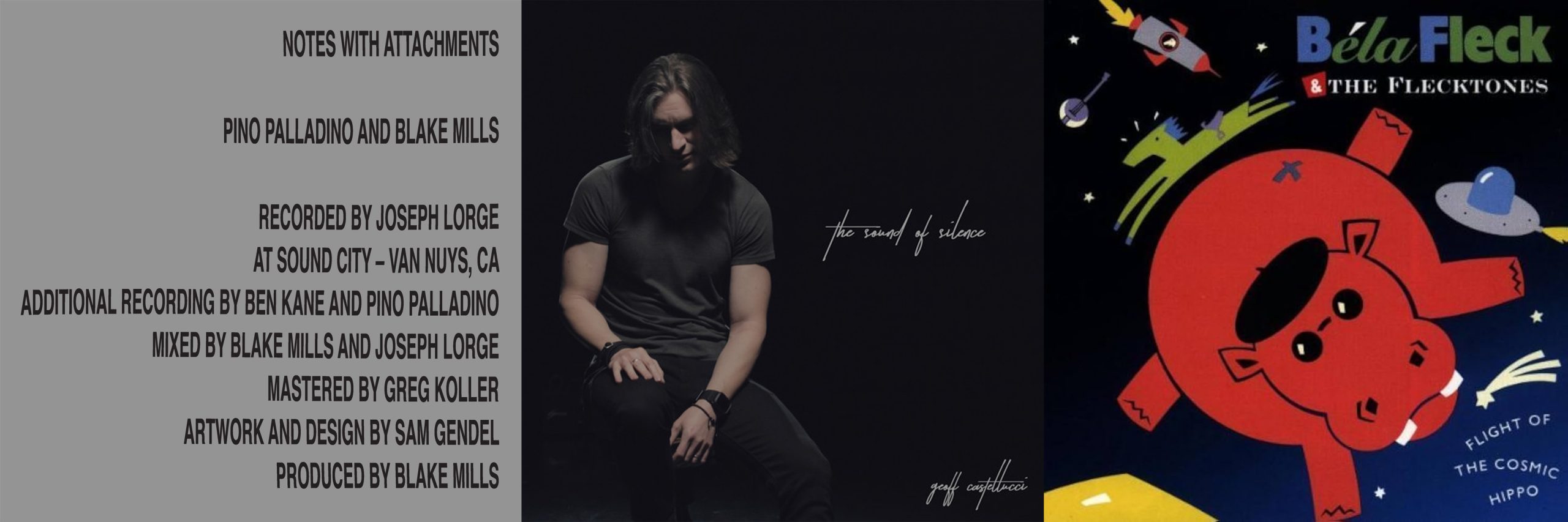
Pino Palladino and Blake Mills, “Notes with Attachments”
Geoff Castellucci, “The Sound of Silence”
Béla Fleck & The Flecktones, “Flight of the Cosmic Hippo”
To qualify my earlier observations about the bass performance of these speakers in my particular room, here are three tracks (out of several) that I use to assess bass when reviewing loudspeakers. They are “Just Wrong” from the album Notes with Attachments by Pino Palladino and Blake Mills, “The Sound of Silence” by Geoff Castellucci, and “Flight of the Cosmic Hippo” by Bela Fleck and the Flecktones. Playing each one of these tracks through the Icon 12 alone sounded excellent in terms of spaciousness, detail, and overall fidelity. Bass extension was linear and quite good, but the deepest bass notes on each of these tracks lacked the volume and visceral impact that I was expecting from them. Playing these tracks again with the Paradigm XR13 subwoofer blended in delivered that output and “gut punch” feel that I was looking for. It made for a seriously impressive combination and immediately got the mind thinking of what these speakers (and sub) could do deployed in a home theater.
Bench tests were performed with a Cross-Spectrum Labs calibrated UMIK-2 microphone connected to my computer workstation using Room EQ Wizard acoustic measurement software.
All near-field measurements were made with the microphone tip centered at the tweeter driver (0-degrees) at a 1-meter distance from the speaker, with the test speaker positioned as far away from any walls as possible. The on-axis (0-degree) response in our nearfield measurements is made flat in the normalization process. As such, the resulting response variations are only due to the changes in either the horizontal or vertical axis.
The In-room average response measurements are derived from an 18-point spatial average taken from around the listening position (11 ft away), with the microphone capsule placed at ear level (roughly 43 inches off the ground).
Phase and Impedance measurements are done using a Dayton Audio DATS V3 Audio Test System.
Caveats: Unlike measurements taken outdoors or in an anechoic chamber that measures a speaker in isolation, in-room measurements give a sense of how a speaker behaves in the actual (often imperfect) environment in which it’s used. Both types of measurements are valuable (make no mistake, a properly designed speaker in an anechoic environment will hold up much better in an average listening space), I just find in-room measurements interesting as they help shed light on what I am hearing and why. Note that no in-room measurement will ever match an anechoic measurement, and a measurement taken in my room won’t necessarily match a similarly done measurement taken in your room. But, after measuring dozens of speakers here, I’ve acquired a good understanding of how this space interacts with the speakers under test, and some general performance observations can always be drawn.
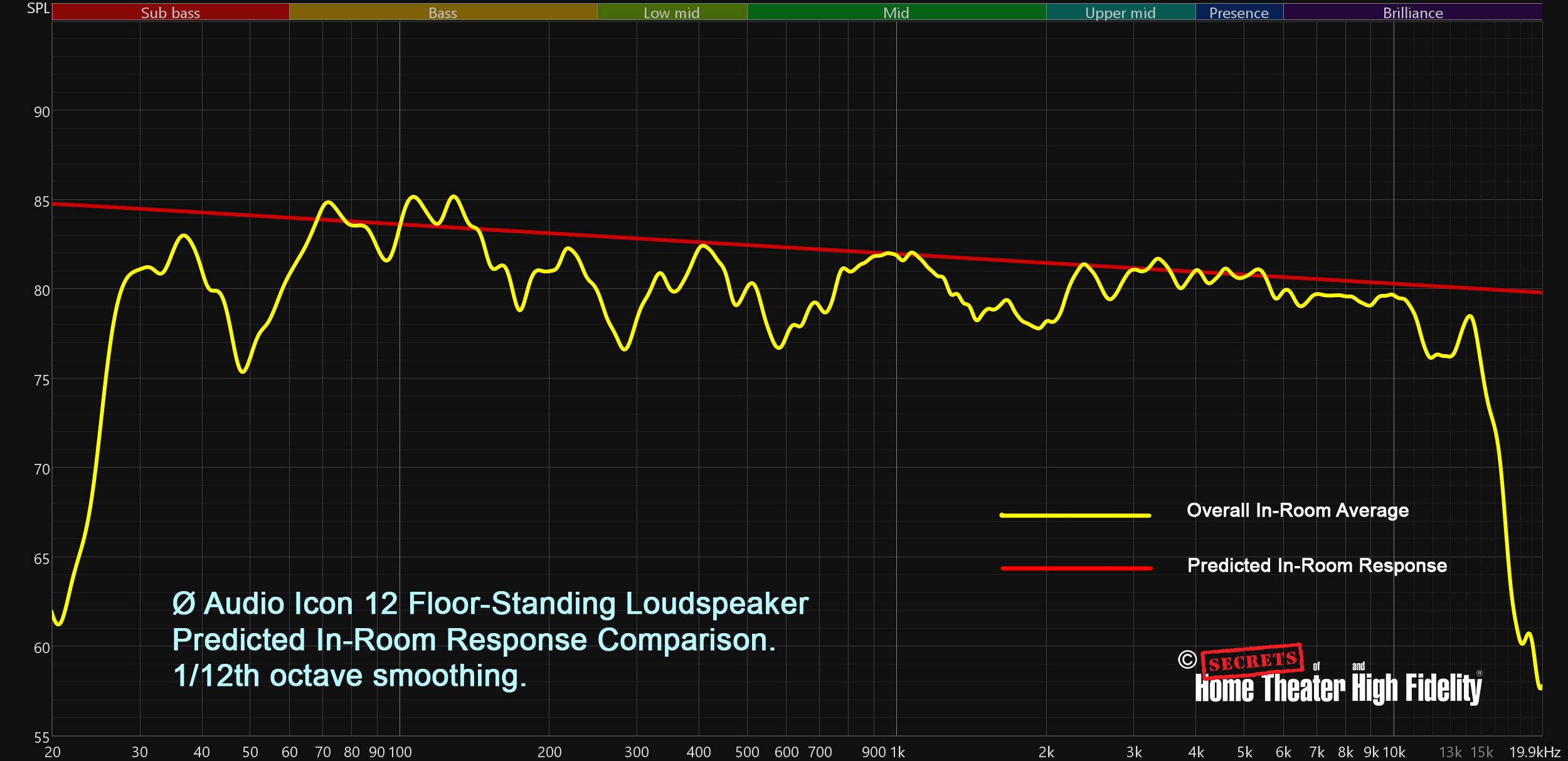
This in-room measurement of the Ø Audio Icon 12 floor-standing speakers is an 18-point spatial average. A 9-point measurement was made for the right speaker and then repeated for the left speaker. Averaging both speakers is an approach others have been using and publishing. Using data from both speakers reduces the modal response of the room by averaging the differences in the response of the two speakers from room asymmetries. The technique cannot eliminate them, however, and so the response below 300Hz remains room-dominated. As you can see from the graph, the speaker and room interaction is causing a noticeable dip at about 50 Hz, which is not unusual in this room. Above this area, there is a good amount of energy between 70 Hz to 150 Hz, which could account for the perceived sense of warmth when factoring in the three energy dips centered at 180 Hz, 280 Hz, and 600 Hz, respectively. There is also a noticeable reduction in energy between 1.2 kHz and 2.4 kHz. This is likely intentional voicing to reduce any potential brightness in that sensitive range. It should be noted that this room has a severe dip at precisely 20 Hz, which is why there is such a steep drop below 27 Hz. This affects every loudspeaker tested in here and is only overcome by using a pair of powerful subwoofers. The Icon 12 would most certainly see some additional bass reinforcement if placed closer to a front wall.
David Rich notes:
The slope is 0.6dB / octave. Speakers with horn tweeters tend to have slower slopes. No correct value exists, but the shallower the slope may result in a subjective response that the speaker is brighter.
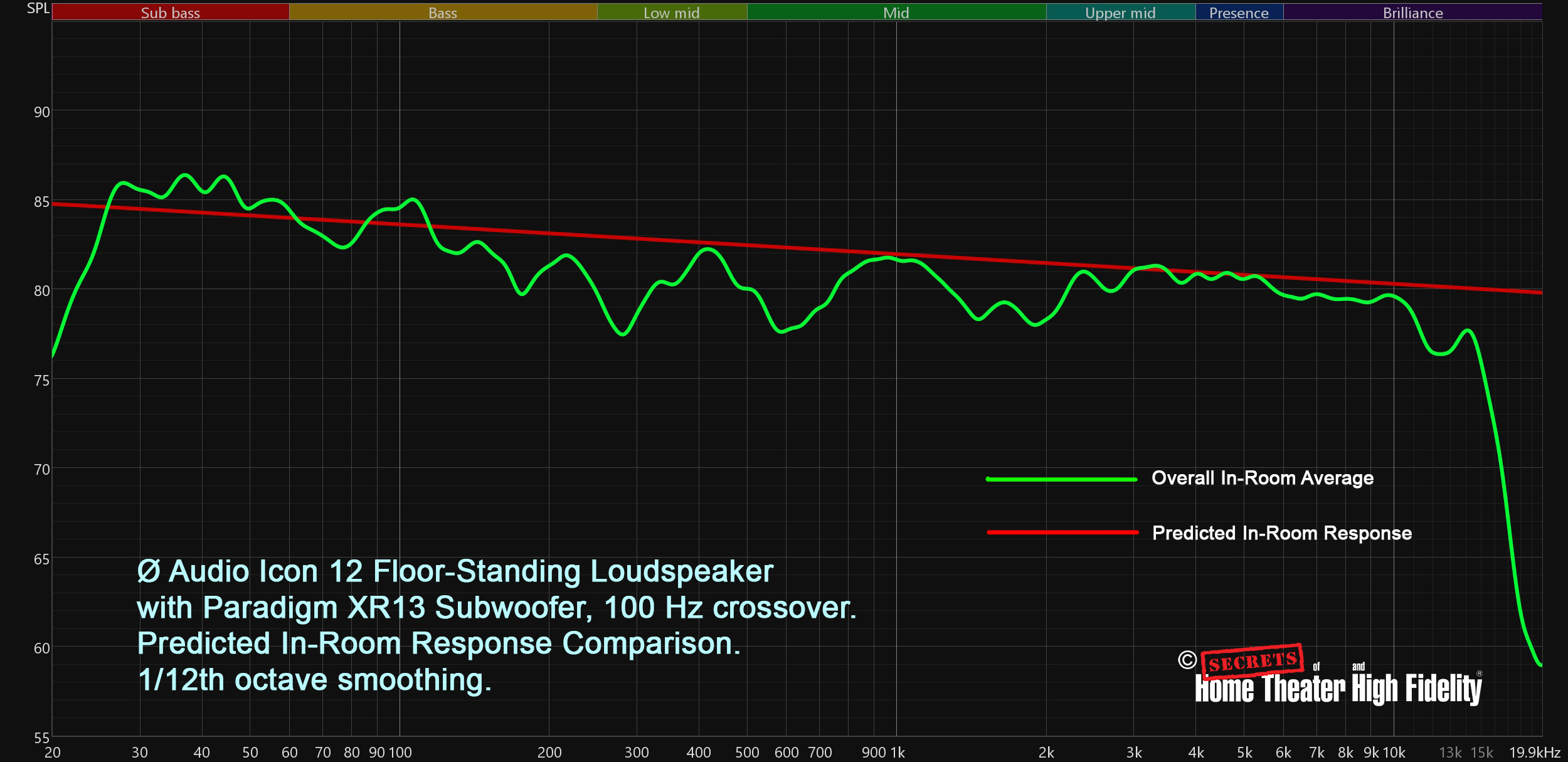
Here is another in-room measurement of the Ø Audio Icon 12 floor-standing speakers, but this time the speakers were integrated with a single Paradigm XR13 subwoofer with a bass management crossover point of 100 Hz using the Eversolo DMP A10 preamplifier. No room correction was applied to the speakers at all, although the ARC Genesis room correction built into the subwoofer was used. The speakers show a good capacity to integrate well with a subwoofer or two.
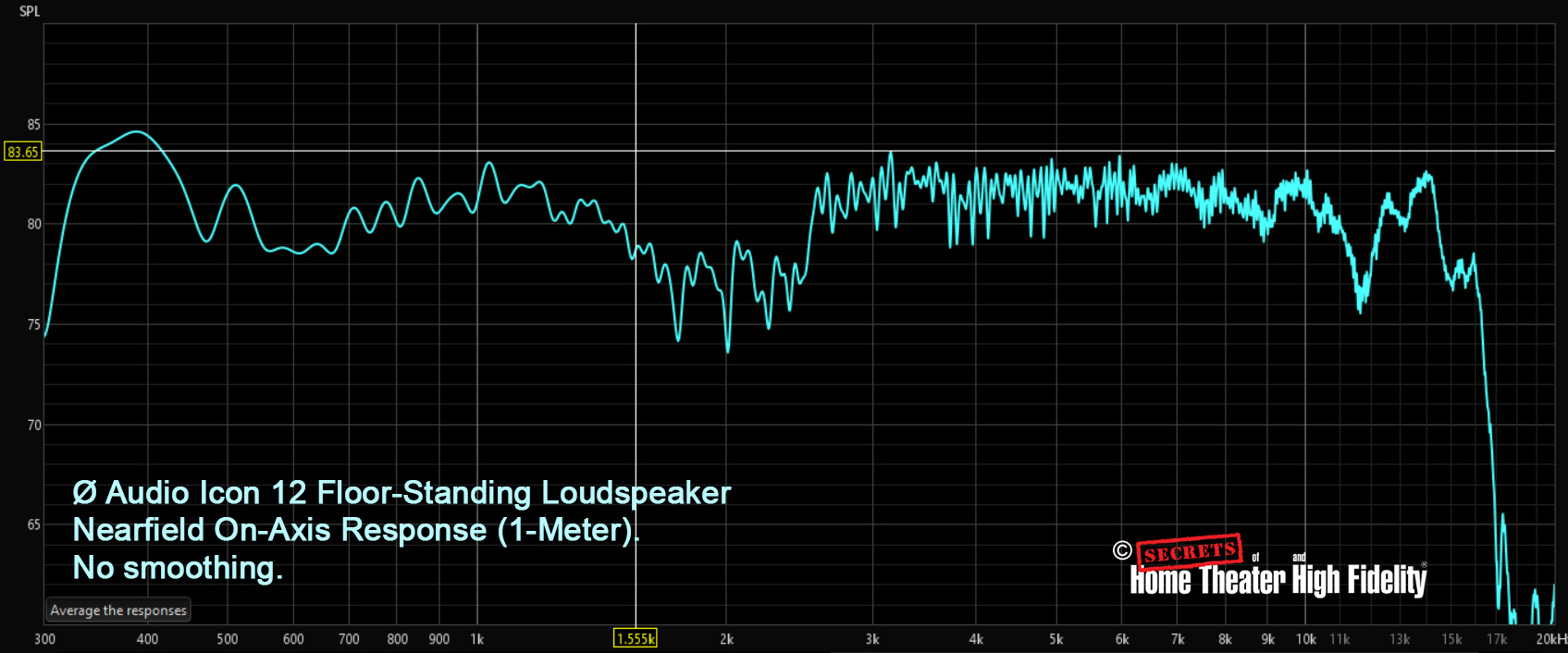
Above is the on-axis response of the Ø Audio Icon 12 at 1 meter from the microphone, scaled from 300 Hz on up. This is windowed to 4 msec and has no smoothing applied. We typically use listening windows to represent the on-axis response of the speaker. With windowing, the response smooths out and takes into account small changes in the loudspeaker’s response in the horizontal and vertical axis.
David Rich notes:
The Ø Audio Icon 12 speaker’s design presents questions of possible resonances. They would inherently be a result of the high frequency at which the 12-inch woofer is crossed over, along with the nature of the horn design itself. As can be seen, the response here is free of resonance. The horn is flat in its response.
The aberrations around the crossover point are not explained in this plot.
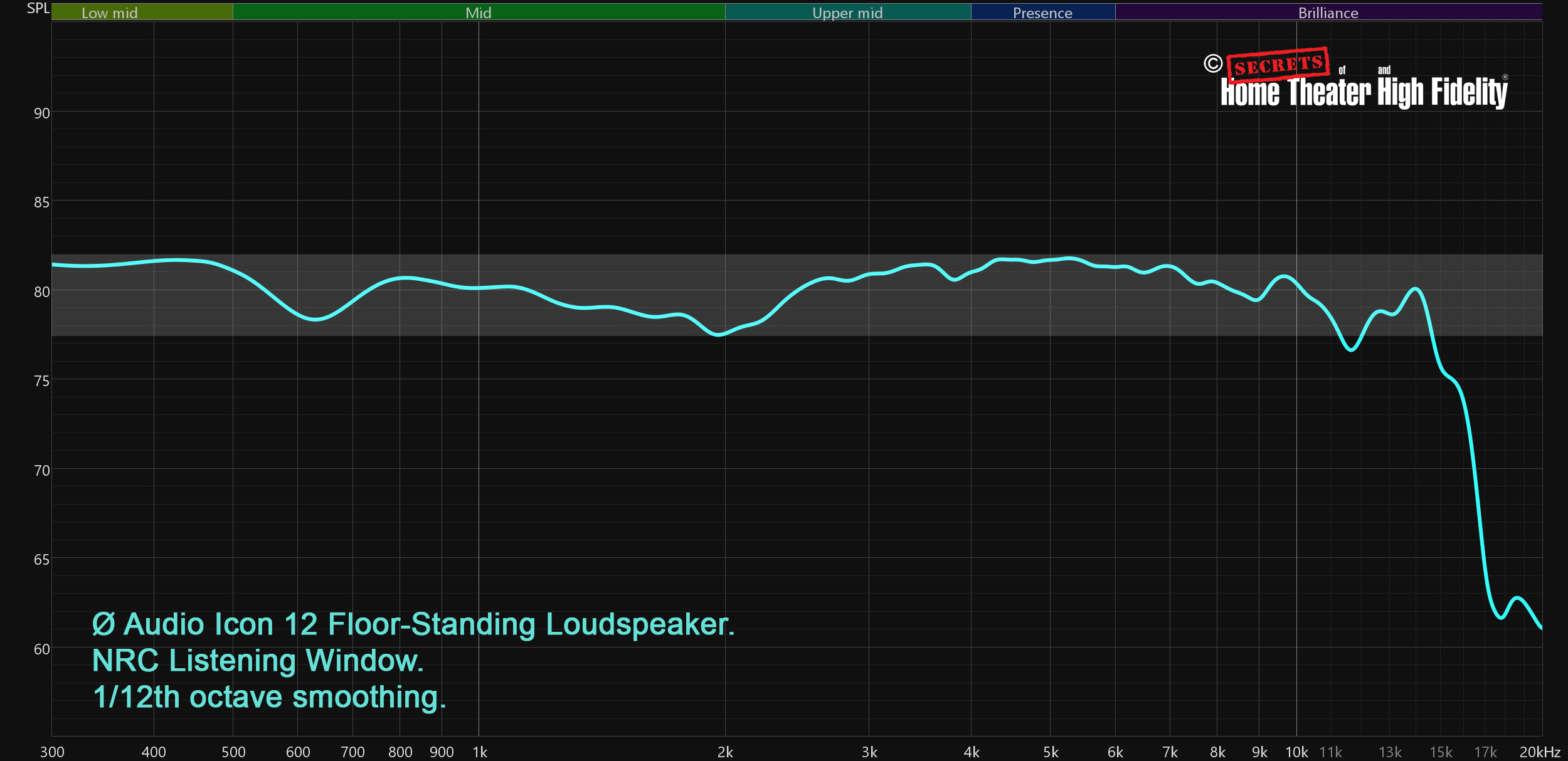
This is a plot of the NRC listening window for the Ø Audio Icon 12, scaled from 300 Hz on up, which is averaged from the following measurements: 0-degree on-axis, +/-15- degrees vertical, and +/-15-degrees horizontal. This is the portion of the frequency range that is dominated by the speaker (response below 300 Hz tends to be dominated by the room and can vary greatly).
David Rich notes:
As we will see below, the vertical response is greatly changed by a small change in the vertical angle. That has a significant impact on this graph, which uses +/- 15-degree vertical mic placements.
The overall shape, with an average of the 5 measurements and smoothing, makes it easier to understand how the dip in the crossover is shaped. The dip is between 1.5 kHz and 2.5 kHz.
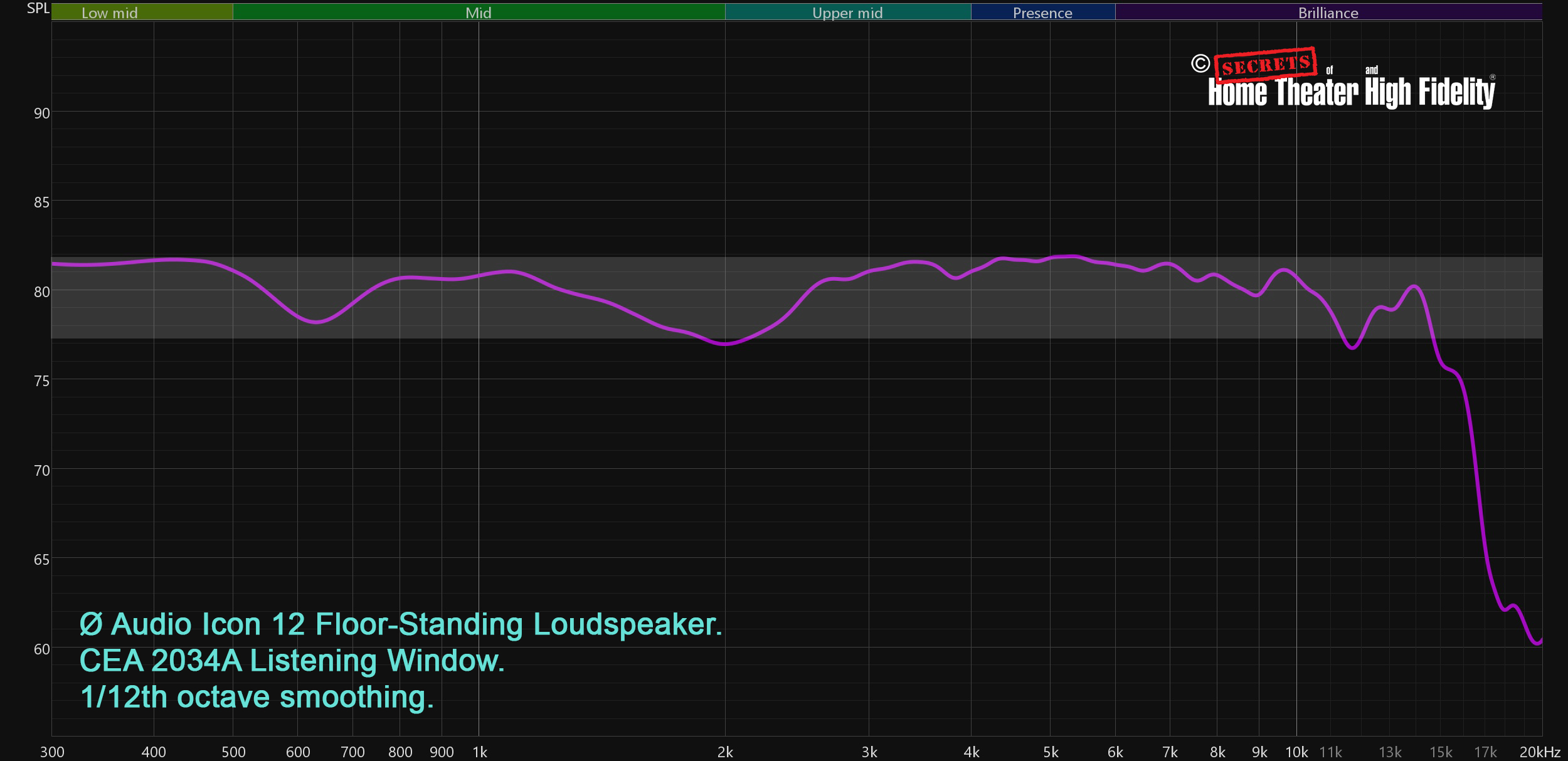
This is a plot of the CEA-2034A listening window for the Ø Audio Icon 12, scaled from 300 Hz on up, which is averaged from the following measurements: 0-degree on-axis, +/-10-degrees vertical, +/-10-degrees, and +/- 20-degrees horizontal. This is the portion of the frequency range that is dominated by the speaker (response below 300 Hz tends to be dominated by the room and can vary greatly).
David Rich notes:
With more horizontal measurement (included in the averaging) and the vertical measurements reduced to +/- 10-degrees, this result may more accurately reflect the speaker’s response.
The 1.5 kHz – 2.5 kHz dip is slightly reduced, but the energy loss extends to 1 kHz,
The in-room response shows a more optimistic picture with the dip starting at 1.2 kHz but coming back to the baseline at 2.2kHz.
The dip from 500 Hz to 700 Hz closely matches the in-room response.
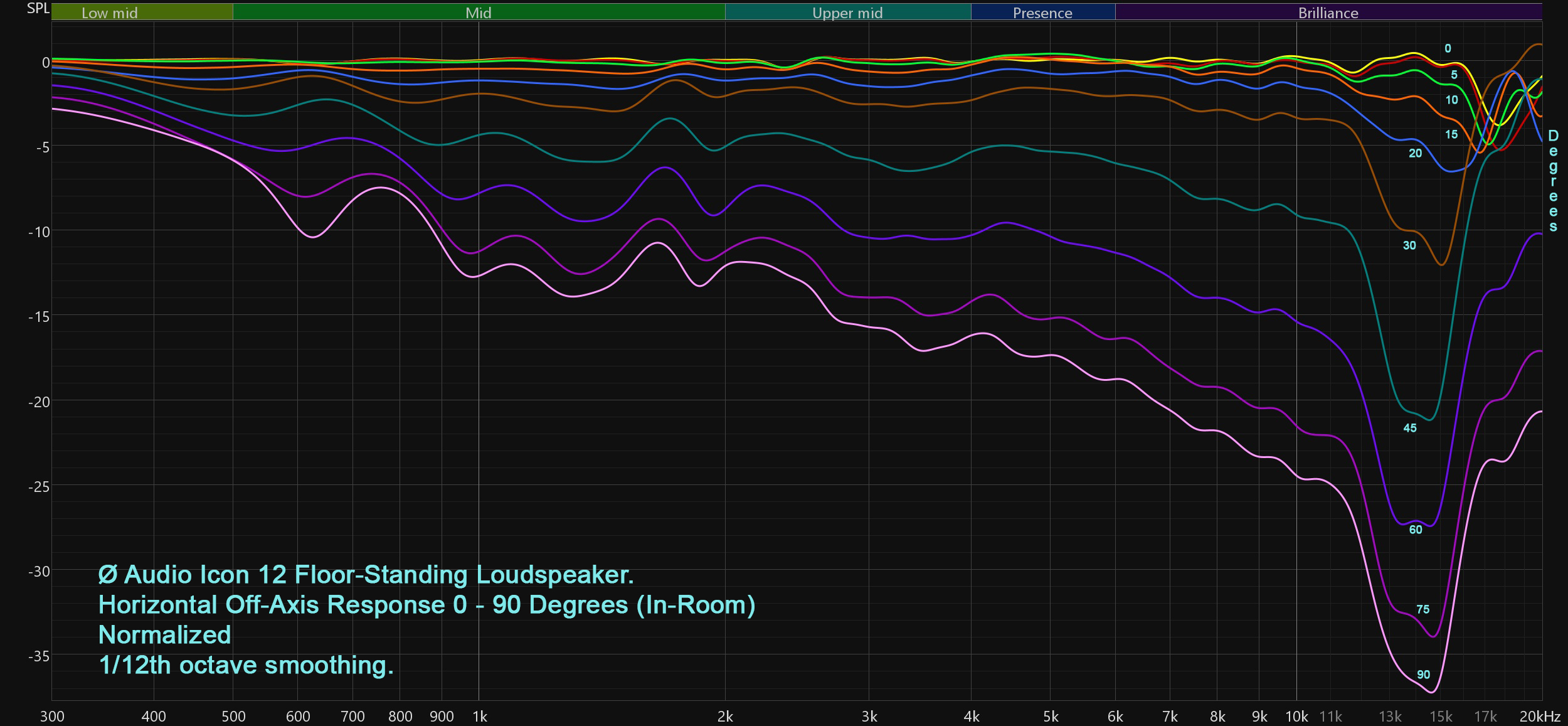
Above are the normalized horizontal radiation curves of the Ø Audio Icon 12 from 0 to 90 degrees, scaled from 300 Hz on up, measured in-room in the near field. In a normalized curve, the on-axis curve is changed to be a flat line, so only the differences in response caused by the changes in angles are seen.
David Rich notes:
This looks excellent. Ø Audio has access to an anechoic chamber. Do not confuse this speaker with the “built-in-the-basement” cone-horn designs sold for high prices at audio shows that appeal more to nostalgia than to actual good design.
The crossover is at 1.7 kHz with a change in radiation pattern, which is why the bump is at that frequency.
Recall this graph is normalized, so the 1.2 kHz – 2.4 kHz dip is removed.
Below 1 kHz, the graph is picking up room reflections. It’s a big speaker being tested in a big room with low ceilings.
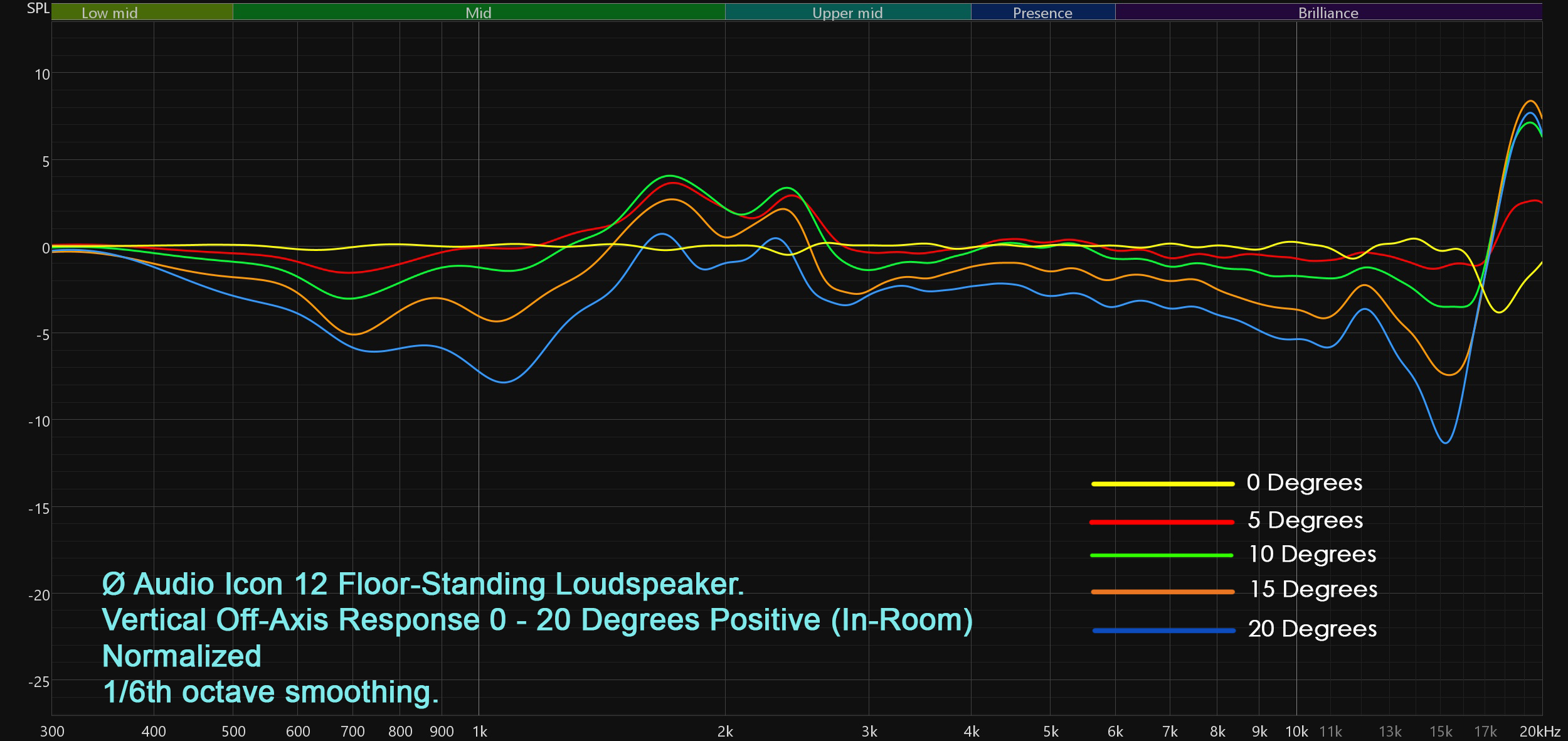
Moving to the normalized vertical radiation pattern for positive angles. We see the plots of 0 to +20 degrees, scaled from 300 Hz on up, measured in-room in the near field.
David Rich notes:
This does not technically look as good as the horizontals, but as we will soon see, the designers have a reason. Note the peaking as well as the energy loss. This indicates the drivers are 90 degrees out of phase at the crossover. The crossover interaction is over a broad frequency range. The large interference effects are from the large horn-to-woofer distance.
What this graph is telling us is that your ear height should be at the center of the horn when listening. A chair with height adjustments would be helpful to get to the ideal spot. Remember that these are normalized curves. Zero degrees is not flat. The response of the speaker without normalization is found in the listening windows above. You could use ear height as an equalizer. Going to 5 degrees produces a peak that fills in the dip seen in the listening windows, but that costs you a large energy loss below 1.2 kHz.
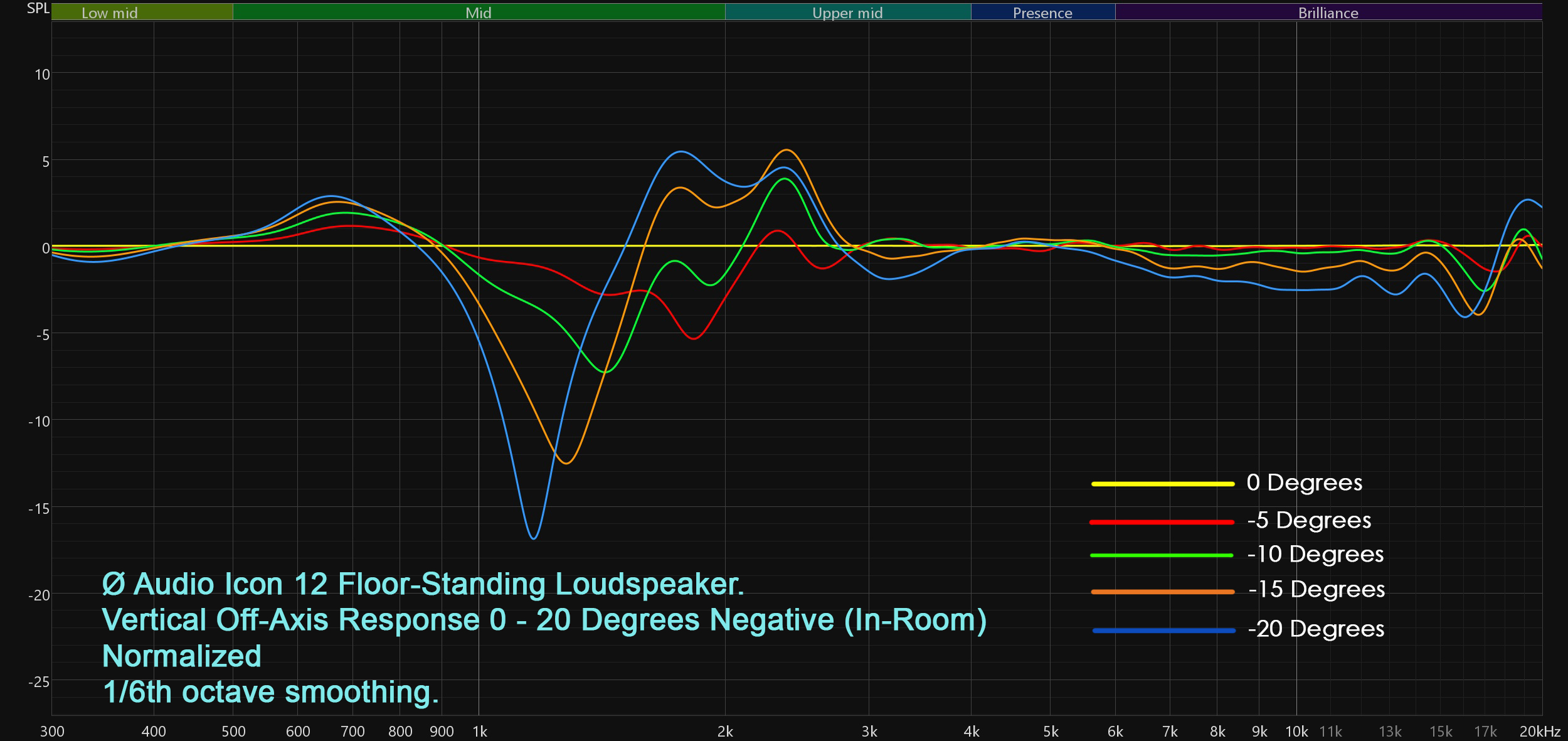
Here we have the normalized vertical radiation pattern for negative angles. We see the plots for 0 to -20 degrees, scaled from 300 Hz on up, measured in-room in the near field.
David Rich notes:
Going down is not better than going up.
You really are locked into sitting at the center of the horn.
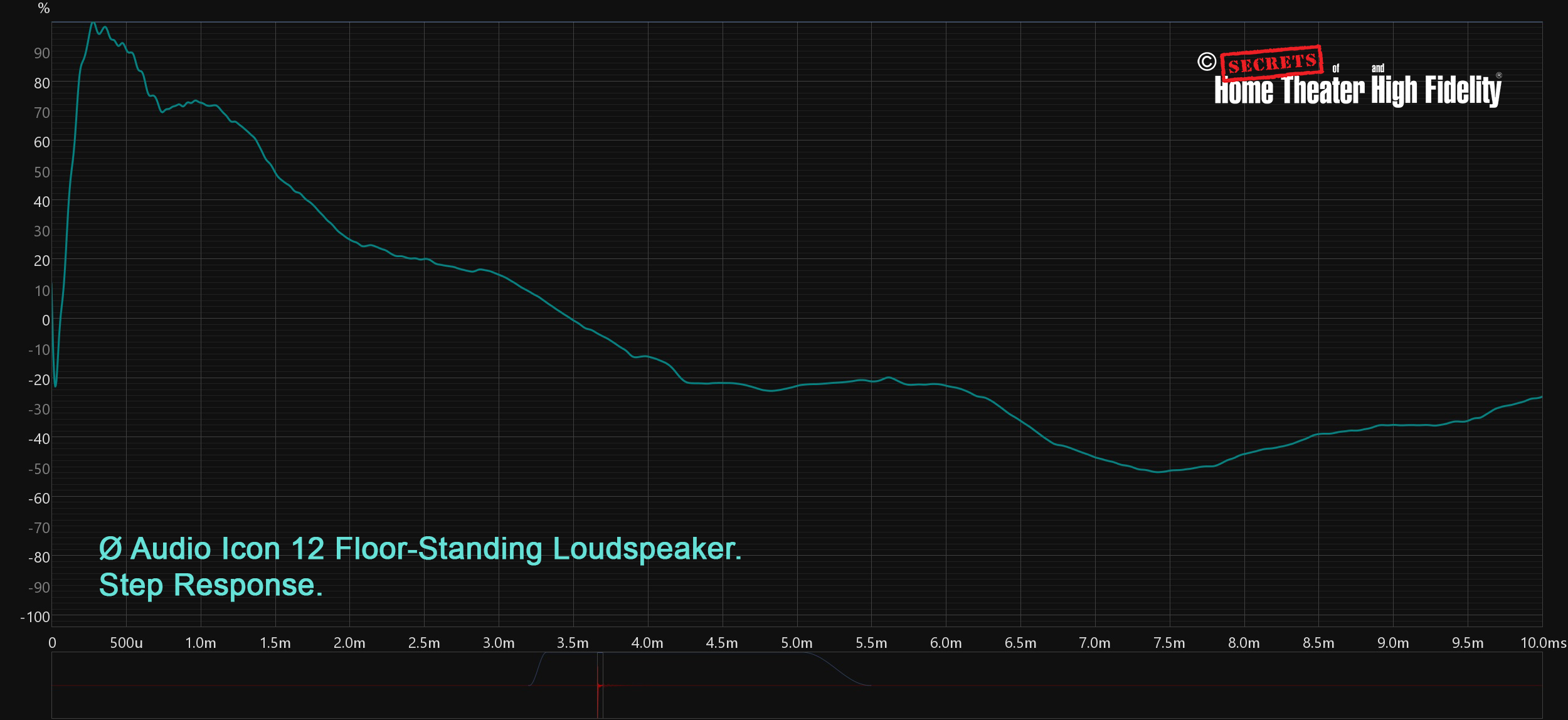
Here we have the step response for the Ø Audio Icon 12 loudspeaker.
David Rich notes:
The specs say this speaker uses 1st-order crossovers, but I figured that was marketing talk or just based on a count of the crossover components.
It turns out to be true. The step response of the speaker shows it is a coherent first-order design.
You pay for this in the unforgiving vertical ear placement, but these types of designs have traditionally had dreadful horizontal radiation patterns. Not so with this speaker. This is a well-designed implementation from engineers with obvious training and experience, coupled with anechoic chambers and Klipple test equipment access.
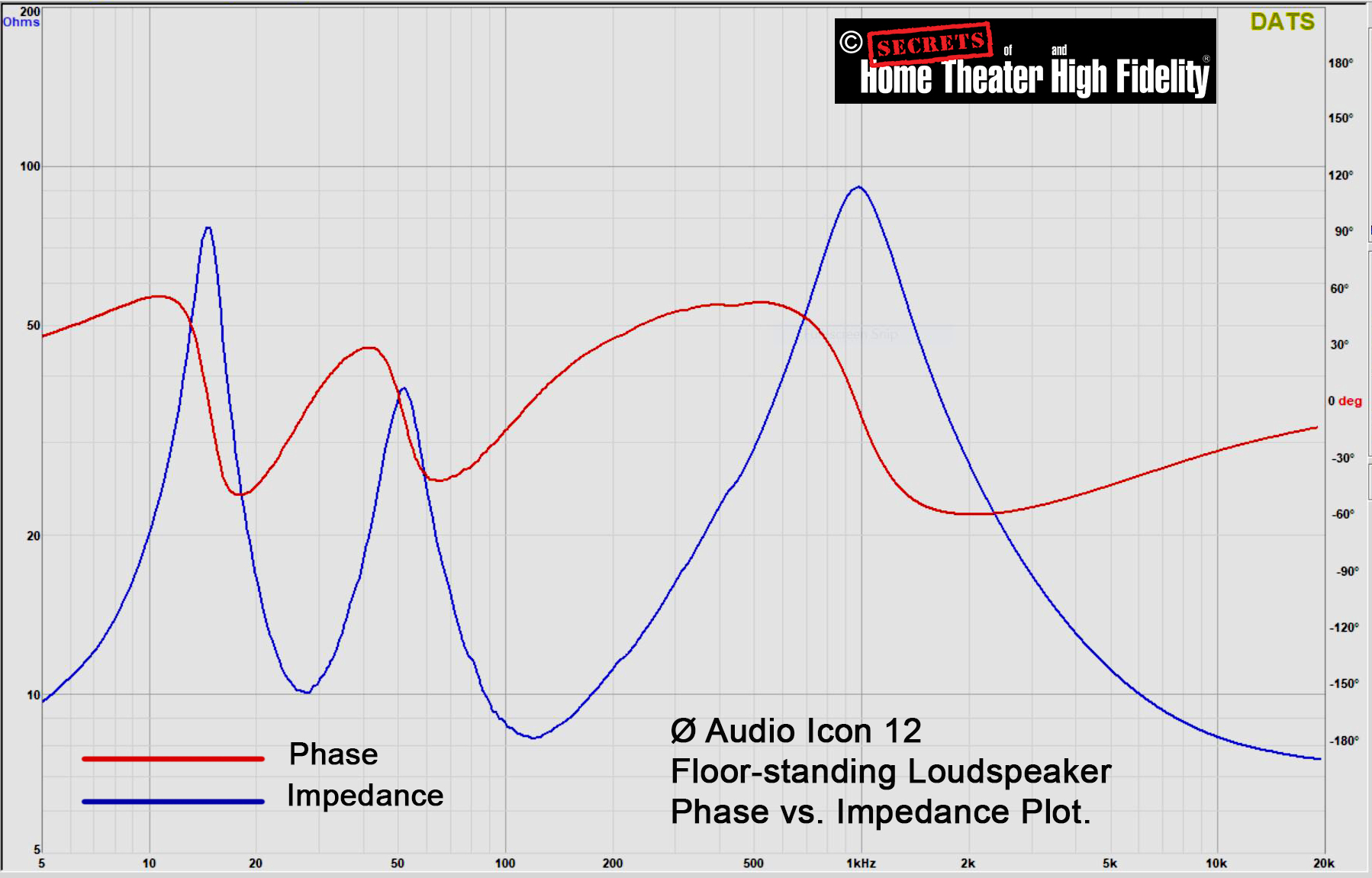
Here we have the Impedance sweep for the Ø Audio Icon 12. The results show that the speaker remains above 8 Ohms for the majority of its operating range. The speaker shows impedance peaks of 78 Ohms, 38 Ohms, and 90 Ohms at 15 Hz, 52 Hz, and 1 kHz, respectively. The speaker hits an impedance low of 8 Ohms at 130 Hz and 7.5 Ohms at 20 kHz. Ø Audio rates the Icon 12 speaker’s nominal impedance as 8 ohms; according to the measurements, this seems rather conservative. Nominal Impedance should be more like 10 Ohms. The Icon 12 should be a relatively easy load for most amplifiers.
David Rich notes:
You see a small dip in the magnitude at 450 Hz along with a corresponding change in the phase. I am not sure what is causing this.
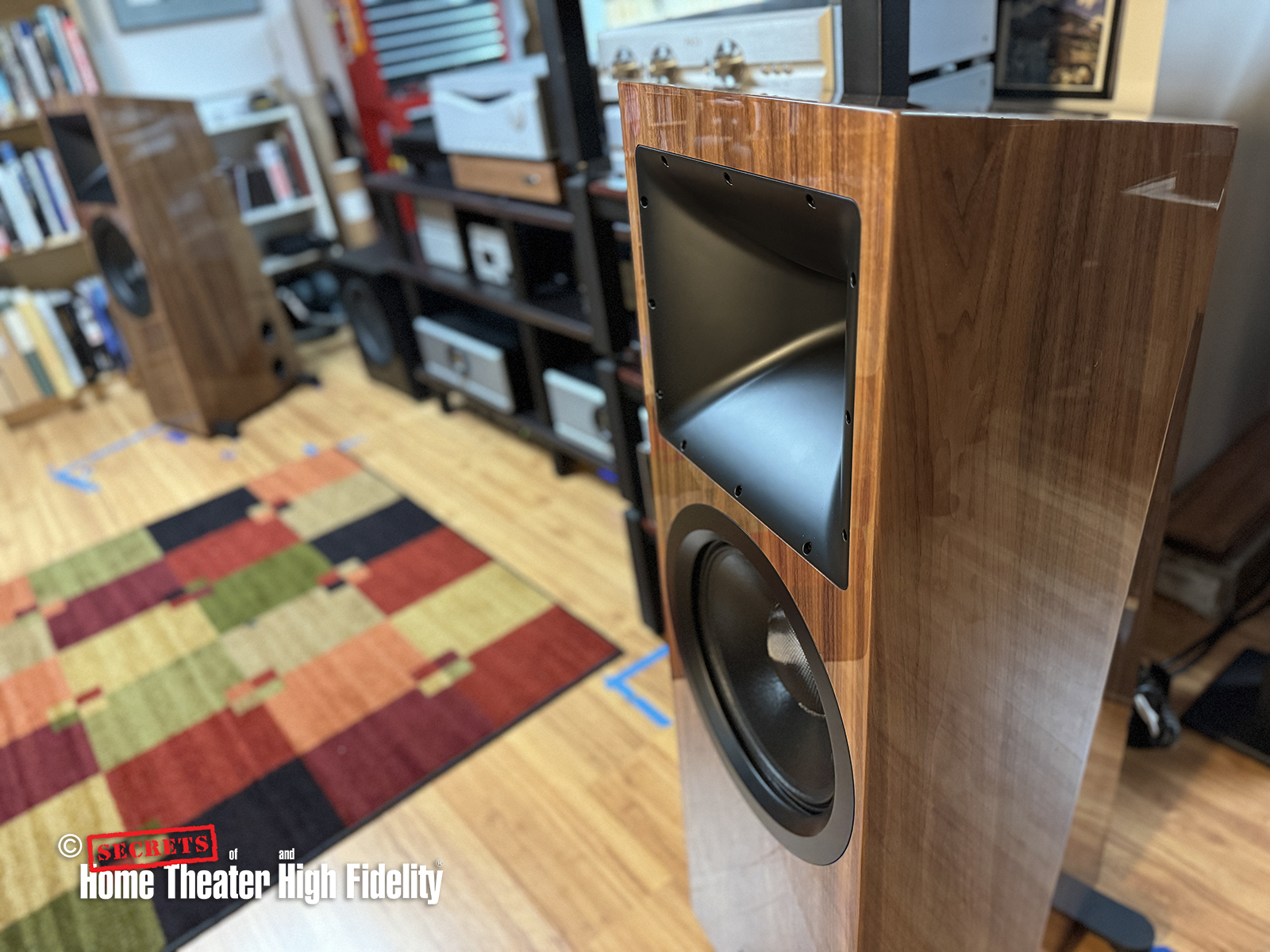
The Ø Audio Icon 12 are an excellent-sounding and beautifully crafted set of speakers from our friends in Norway. And while it’s fun to wax poetic about Norse Mythology here, these speakers are no myth. They deliver the sonic goods in a very real way!
- Extremely dynamic and easy to drive.
- Generates a big, cohesive soundstage from the large 2-way design.
- Plenty of detail but not fatiguing to listen to.
- Beautiful finish and build quality.
- Bass reproduction is very good, but, in my case, adding a subwoofer took it to the next level.
- Nothing of consequence.
Ø Audio has a very interesting and compelling set of speakers on their hands with the Icon 12. It is a very well thought-out and highly efficient design that should be suited for a wide range of listening systems (tube amp fans, take note). It has an immediately appealing sound quality and presentation that invites long listening sessions, and while I enjoyed them with all kinds of music genres over digital media, I felt that the Icon 12 really worked some magic with my vinyl collection. I listened to a boatload of LPs during the review. My records just sounded like they had a little extra “meat” on them when I listened through the Icon 12. These speakers are not delicate shrinking violets either; they like to be played loud, and they will do so without any hint of strain or compression. There is perhaps an unfair expectation that these speakers would sound bright or shouty when you get a look at that substantial horn waveguide, but the results couldn’t be further from the truth. It’s a very approachable, appealing, and easy-to-live-with kind of sound that the Icon 12 delivers. It’s a real speaker for real music, not an audiophile “show pony” that demands just the right tracks to make it sound its best.
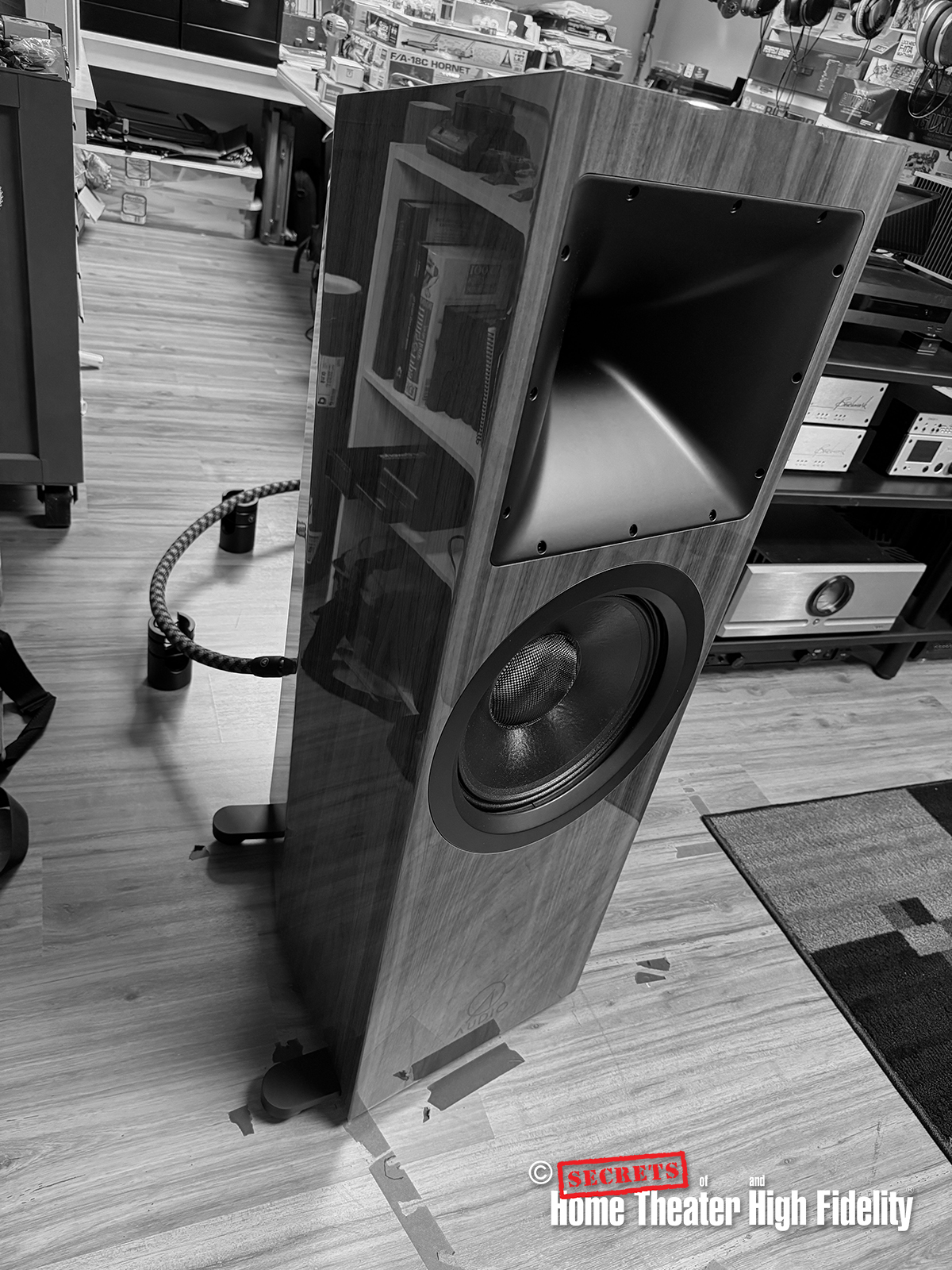
Then we come to the build and finish of the speakers, which is undeniably top-shelf in every respect. The beautiful gloss walnut finish was exceptional, and every point of physical contact with these speakers clearly spoke to the quality and attention to detail. They both felt and sounded like they were worth the money. As a big two-way, they delivered sound especially well with sufficient bass to satisfy on most types of music. But in a big room like mine, I think they really came into their own when adding a suitable subwoofer and relieving the Icon 12 from having to handle that lowest octave of sound. In that configuration, these speakers were unstoppable. That would be my only real issue with these speakers, and that probably wouldn’t really apply if they were placed in a more traditional space, closer to the walls.
I very much enjoyed my time with these speakers and recommend the Ø Audio Icon 12 wholeheartedly. They sound great, rely on solid technical engineering, and have a unique, unmistakable character. Hunt them down and have a listen. Valhalla awaits!
Manufacturer’s Response:
At Ø Audio, engineering is the foundation, but it is not the finish line. Every loudspeaker we build is developed as a complete system, designed to perform not just on paper, but in real rooms, with real music, over time.
The Icon 12 was conceived as a modern expression of a proven idea. High efficiency, wide dynamic range, and controlled directivity, executed with contemporary tools, materials, and discipline. Its large two-way architecture, proprietary compression driver, and constant directivity waveguide were developed together as a single platform, with a clear focus on low distortion, consistent dispersion, and effortless dynamics.
Icon 12 is designed as a full-range loudspeaker, intended to deliver a complete musical experience on its own in typical living spaces. As with any high-performance design, room size and placement matter. In larger rooms or systems built for maximum scale, some listeners may choose to extend the lowest octave with subwoofers. Others will find the speaker fully satisfying when placed closer to traditional room boundaries. Both approaches are valid, and neither changes the original design intent.
All drive units used in the Icon 12 are proprietary Ø Audio designs, developed specifically for this speaker and manufactured to our specifications. Measurements play a critical role in our development process, but final voicing is always confirmed by ear, with music as the reference.
We come from Norway, where things have traditionally been built to last, not to impress at first glance. Icon 12 reflects that mindset. It is meant to be trusted, played loudly, and lived with over time, not simply admired in passing.
We appreciate the depth and care you have brought to this review and thank Secrets of Home Theater and High Fidelity for the opportunity to share the thinking behind the Icon 12.
Ø Audio