 YouTube
 Facebook
 X
X LinkedIn
 Pinterest
 Instagram

 John E. Johnson, Jr.
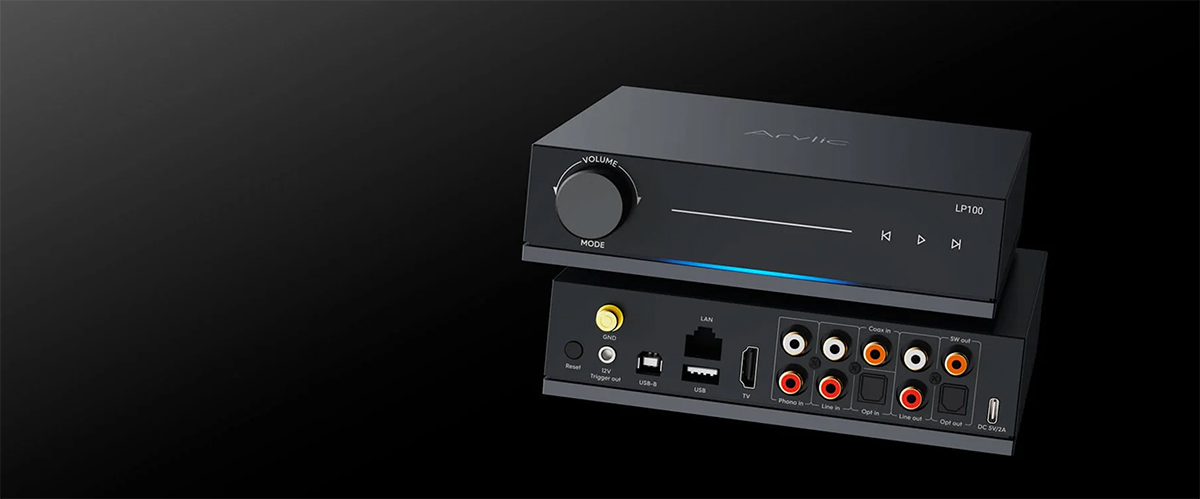
Arylic LP100 Wireless Music Streamer
- Tons of features
- Inexpensive
- Even has a phono stage
- HDMI eARC input
- Native wireless streaming (AirPlay 2, Google Cast, Spotify Connect, Tidal Connect, etc.)
- The next firmware update will include:
Qobuz Connect support
Spotify lossless streaming
Arylic is a company that consumers on a budget know about. If you dole out your dollars cautiously, they are probably already on your radar. But in case you don’t . . .
The Arylic LP100 Wireless Music Streamer arrives as a surprisingly full-featured digital hub aimed squarely at listeners who want modern connectivity without modern sticker shock. At $399, it occupies a rare space: inexpensive enough for students, desktops, and secondary systems, yet stocked with the kind of inputs, outputs, and wireless protocols usually reserved for pricier components. With support for AirPlay 2, Google Cast, Spotify Connect, Tidal Connect, Wi-Fi, Bluetooth LDAC, Auracast, and even Roon connectivity, the LP100 is built to handle virtually any everyday listening scenario. Add to that HDMI eARC, phono input, USB-A and USB-B playback, coaxial and optical I/O, line-level connections, a subwoofer output, and a supplied remote, and you have a compact streamer-DAC that strives to be a complete small-scale audio command center.
While the LP100 is not intended to compete with audiophile-grade DACs, its value proposition comes from breadth rather than ultimate signal purity. The inclusion of AKM’s updated AK4493SEQ Delta-Sigma DAC chip gives it a strong technical foundation, but expectations should be framed around convenience, versatility, and overall usability rather than chasing state-of-the-art measurements. As a do-everything streamer-DAC designed for real-world listening, the LP100 offers a lot for its asking price and sets itself up as an appealing budget-friendly solution for modern music playback.
WiFi:
IEEE802.11 b/g/n 2.4GHz, 5GHz
LAN:
10/100M RJ45
Bluetooth Transmit Codecs:
SBC, AAC, aptX, aptX HD, aptX LL, aptX AD, LDAC, LC3
(Connects to 1 Bluetooth speaker or headphones)
Bluetooth Receive Codecs:
SBC, AAC, aptX, aptX HD, aptX AD, LDAC, LC3
(Connects to 2 smartphones)
Broadcast:
Auracast, 10m
Streaming Protocol:
WiFi, AirPlay 2, Google Cast, Spotify Connect, Tidal Connect, Roon Ready, DLNA, UPnP
Frequency Response:
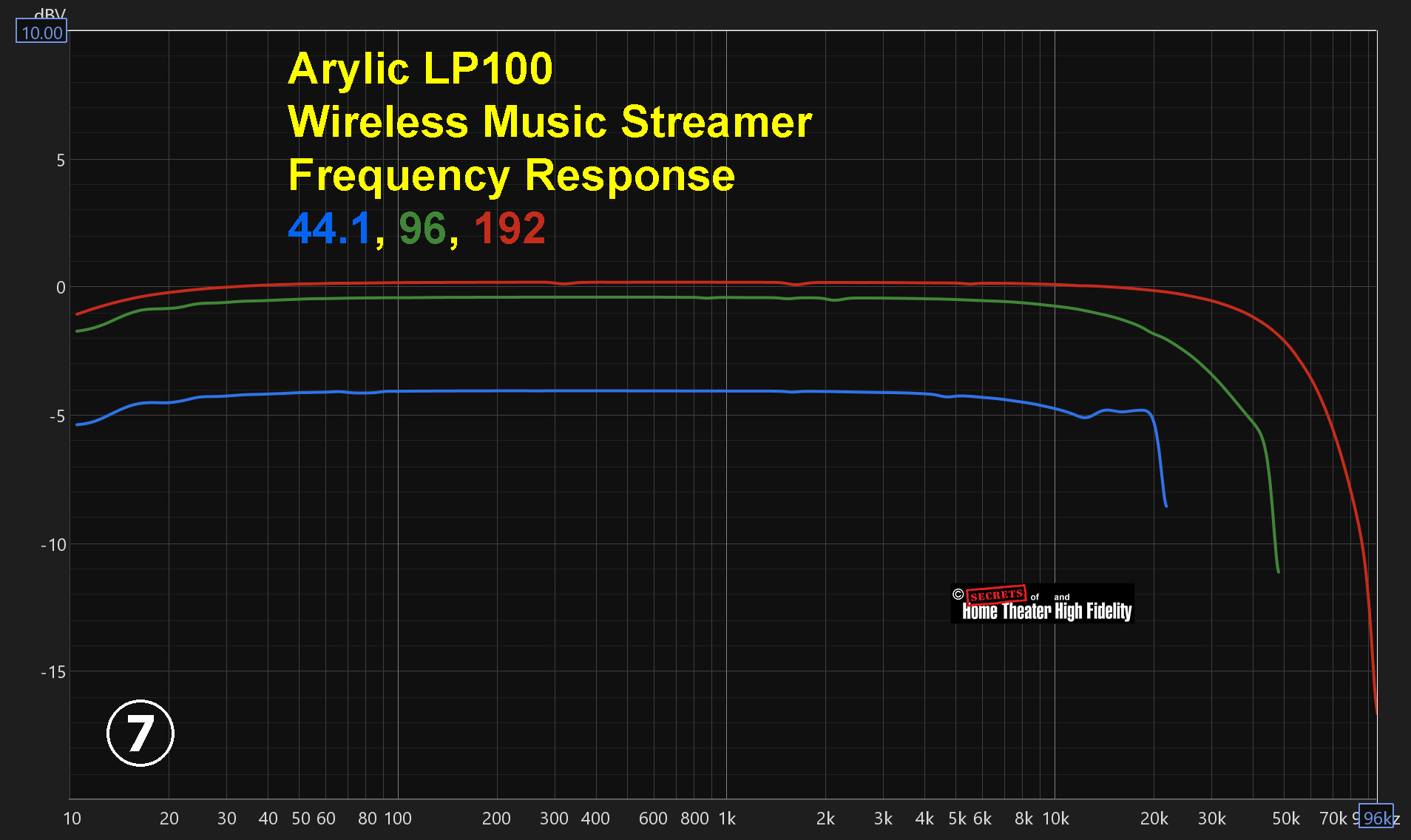
20Hz-20kHz±1 dB
THD+N/SNR:
≤0.001 %/≥80 dB
Crosstalk:
≥80 dB
DAC Chipset:
AKM AK4493SEQ
ADC Chipset:
AKM7735
SRC Chipset:
CT7302SL
Audio Input:
RCA Input x1 2 Vrms
Phono Input x1, MM / MC, RIAA EQ Built in
Optical Input x1, PCM only, up to 192kHz/24bit
Coaxial In x1, Up to 192kHz/24bit
HDMI eARC Input x1, PCM only, CEC function supported
USB Host x1, USB disk drive playback, support resume playback. Storage format: FAT16, FAT32, exFAT, up to 128 GB. Support codec: mp3, wma, m4a, aac, flac
USB-B DAC x1, For PC connection, Sample rate: 44.1~192kHz
Local Music, NAS, Mobile device music, USB flash drive music files
Outputs:
Speaker Out x1 Banana Plug
Line Out x1 RCA, Max 2 Vrms output
Optical Output x1 Up to 192kHz/24bit output
Subwoofer Out x1 Max 3 Vrms output, Crossover frequency: 250Hz
Support simultaneous audio output.
Remote Controller
BLE remote control
Lifestyle knob control (optional)
Power Input:
USB Type-C Port 5V/2A
Dimensions:
167 x 167 x 43.5 mm
Weight:
550g
Trigger Out:
12V
Package Includes:
LP100 x1
BLE Remote Controller x1
Manual x1
5V/2A Power Adaptor x1
2-2 RCA Cable x1
USB Type-C Power Cable x1
USB Type-B Data Cable x1
MSRP:
$399 USD
Website:
Company:
SECRETS Tags:
Arylic, LP100, Wireless Music Streamer, Music, Streamer, Music Streamer
The LP100 is available at a 20% discount during this period:
– Black Friday page: https://www.arylic.com/pages/2025-black-friday
– Direct product link: https://www.arylic.com/products/lp100-music-streamer
Secrets Sponsor
The AK4493SEQ DAC chip used in the Arylic LP100 is the updated version of the AK4493EQ. There is not a lot of information on its performance, so let’s look at the previous version.
The AK4493EQ from Asahi Kasei Microdevices (AKM) is a high-quality stereo 32-bit DAC chip that offers exceptional technical performance and is widely used in premium audio devices. Here’s an overview of its quality—both in terms of specifications and real-world implementation.
Key technical specs and strengths
Some of the standout specifications from the datasheet:
● Supports PCM up to 768 kHz and DSD up to 22.4 MHz. Digi-Key Media+1
● Signal-to-noise ratio (S/N) of around 123 dB (with some modes up to ~126 dB) for the stereo configuration. Arrow+2Digi-Key Media+2. The SEQ version touts 128 dB.
● Total harmonic distortion + noise (THD+N) in the range of -113 dB or better in certain modes. Arrow+1. The SEQ version THD+N is -115 dB.
● Offers selectable digital filters (six types) and a dedicated audio process (“VELVET SOUND™” architecture) to optimize sound performance. Digi-Key Media
These specs and the experiences with the earlier version place it in the “premium” DAC chip category — excellent numbers, very low distortion and noise, high sample-rate capability. For many high-fidelity audio designs, this is more than sufficient to be essentially transparent (i.e., the DAC chip is unlikely to be the limiting factor in the sound chain).
Real-world caveats:
While the chip itself is very strong, the overall sound quality you get from a device using this chip depends a lot on the surrounding implementation (power supply, PCB layout, analog output stage, clocking, filtering, etc.).
A few observations:
● On forums, some users note that “there’s more to a DAC than just which model IC it uses.” Reddit+1
● In DIY audio discussions, people say: “Regarding the AK4493 DAC you linked to … it will probably sound better stock than the ES9038Q2M board. However … the implementation is still too lacking in quality (which would also be evidenced by the presumably 2-layer PCB I think you would find).” diyAudio
● Subjective impressions: Some audiophiles describe AKM chips (including the AK4493 series) as “more balanced, bassier, smoother … captures the tone and notes of individual instruments so well.” Head-Fi
In short, the chip’s performance ceiling is very high, but you’ll only reach near that ceiling if the board/analog section/clocks/power are well designed.
Considering a DAC device or design using the AK4493SEQ, here are practical points:
● If the device using this chip has good analog output circuitry, a low-noise power supply, and careful layout, then you’re likely getting top-tier performance from the DAC stage.
● If the device is budget-friendly, uses this chip with minimal analog front-end, cheap power supply, etc., then you might not experience (or hear) the full benefit of the chip — it could still sound very good, but the DAC chip will not be the limiting factor in a good system.
● When designing your own board, pay attention to things like analog output filter design, ground/return layout, clock jitter, decoupling of supplies, and more. The chip offers high performance potential, but proper implementation is key.
● If you compare it to other popular high-end chips (e.g., from ESS, Cirrus Logic, etc.), you’ll find that differences in actual equipment often come from implementation rather than just “the chip X vs chip Y”.
The AK4493SEQ is a top-tier DAC chip that can easily handle demanding high-fidelity applications. When integrated properly into a well-designed system, it provides a very solid foundation for great sound quality. The main caveat is: don’t assume the chip alone guarantees “amazing sound” — the rest of the circuit design is also important.
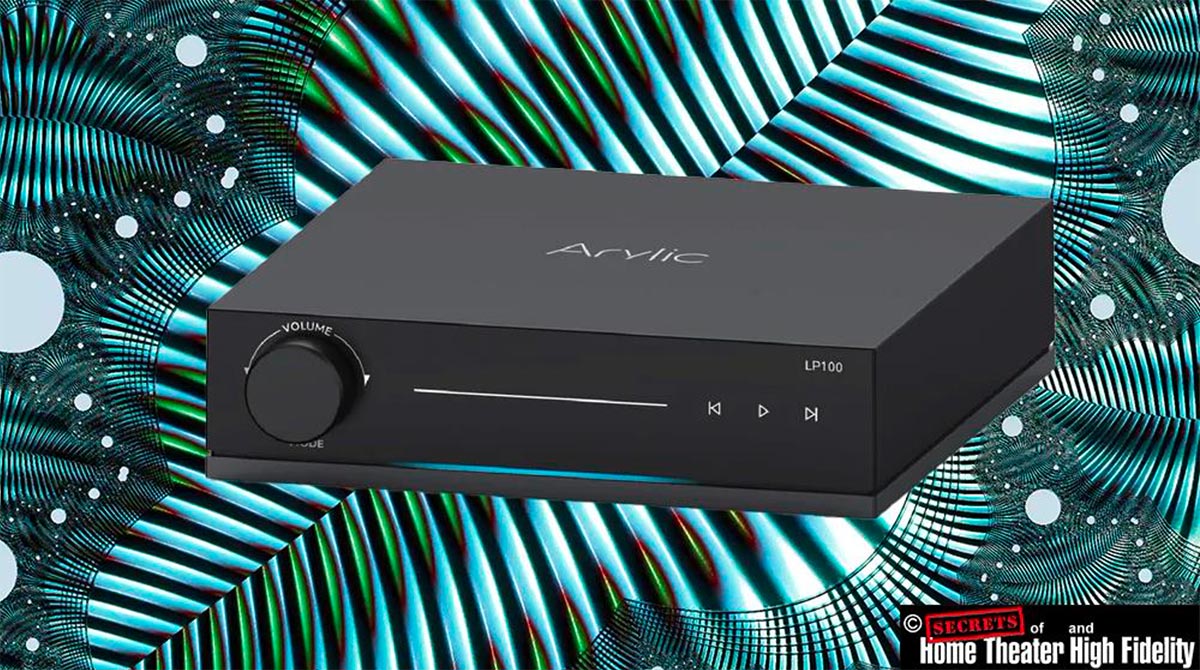
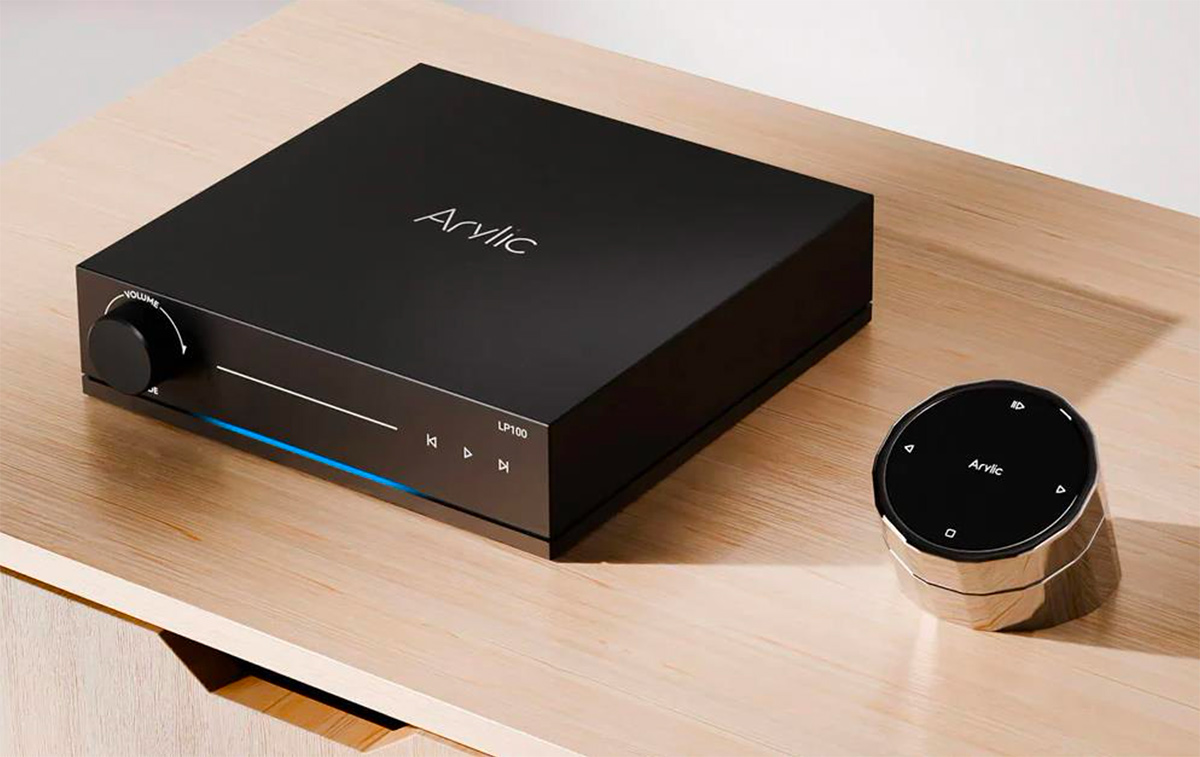
The LP100 is Bluetooth-capable and can stream from all types of sources: GoogleCast, AirPlay, Spotify, Tidal, and Auracast.
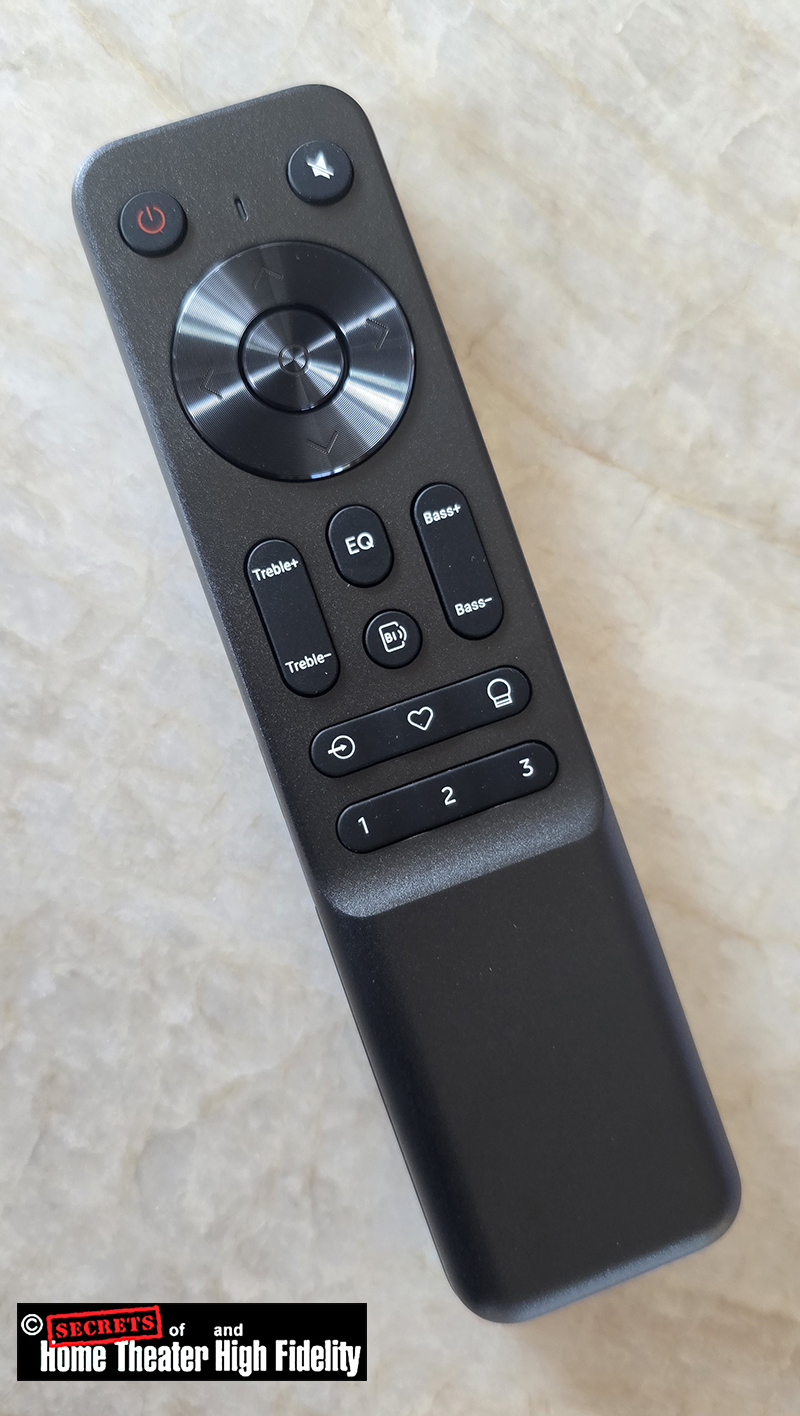
A remote control is included, and you can also download the Go Control app, which works with the LP100.
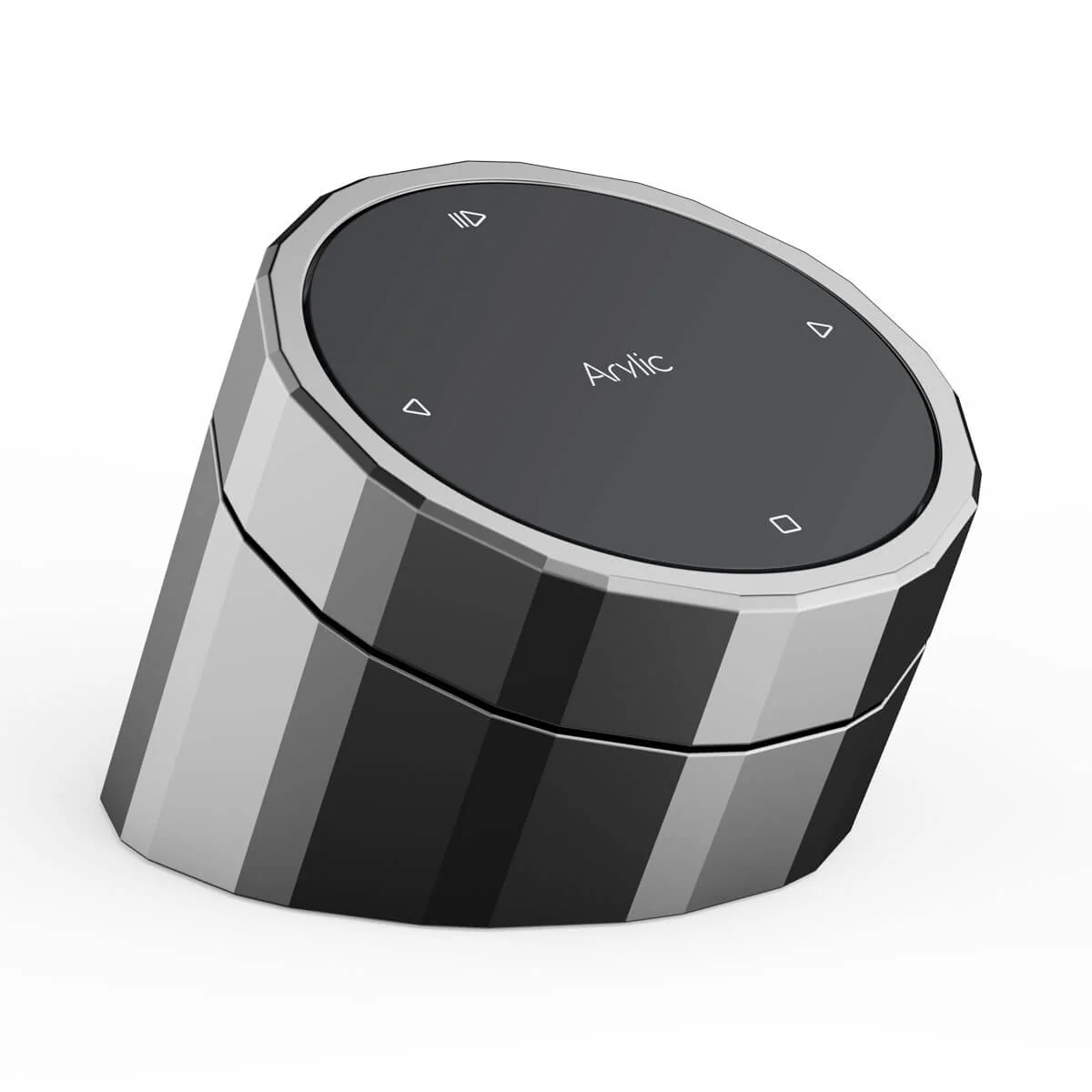
The BK01 Remote Control, for an additional $79, lets you control the LP100 from your desktop.
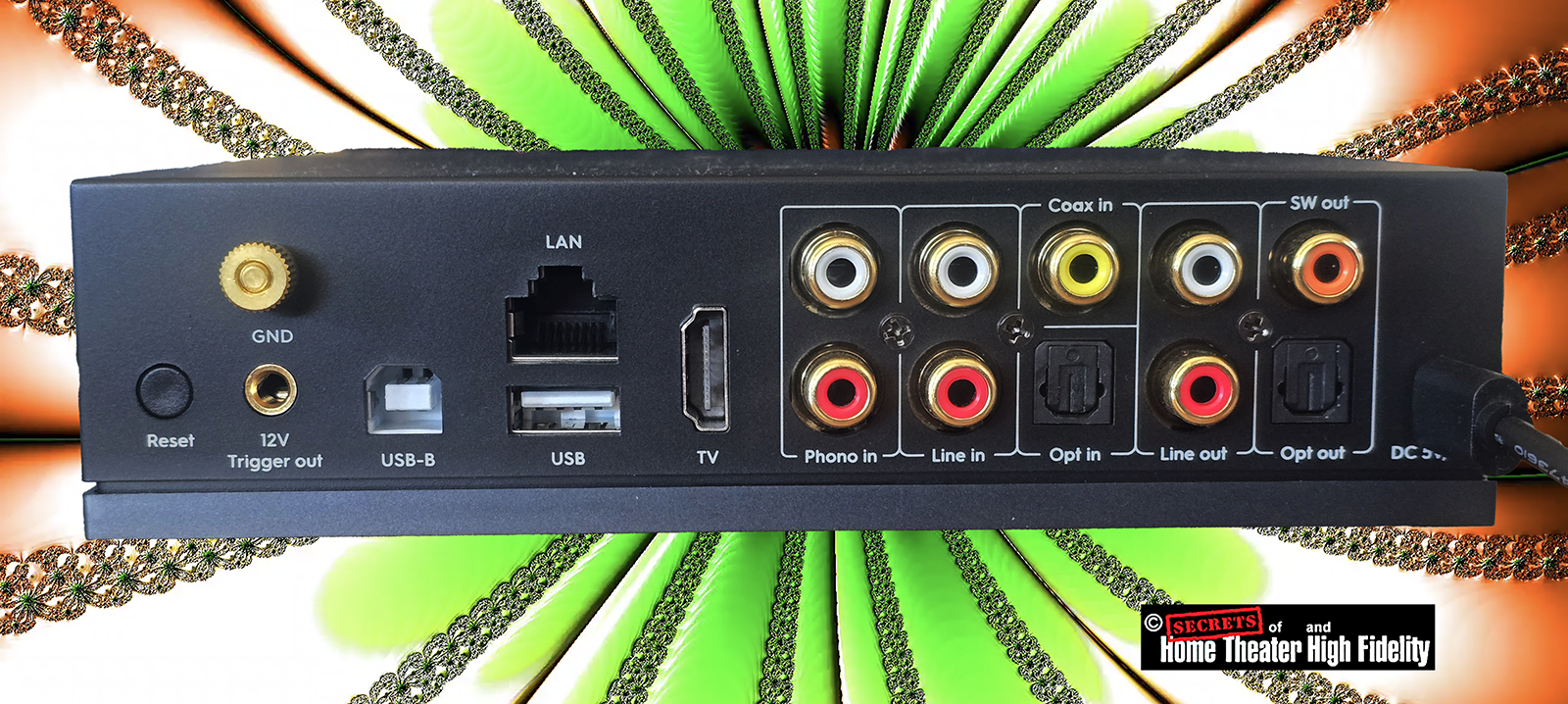
The rear panel (shown below) features a wide range of connections, including USB-A, USB-B, Optical In, Optical Out (the LP100 has an ADC), Line In, Line Out, and even a Phono Input. The DC power input jack is located on the far right and uses the included DC wall wart power supply.
When powering up the LP100, the front panel will glow different colors depending on the selected input. To turn it on, you depress the volume control knob. Then, to select an input, push the volume control knob in and out until the input you want is displayed acording to the following colors: Blue – Bluetooth; Green – RCA Line In; Purple – HDMI; Yellow – Optical In; Lime Green – Phono Input; Orange – Coaxial Digital Input; Red – USB-A (for playing music stored on a disc plugged into this jack on the rear); Magenta – USB-B (digital output from your laptop).
I tested the Arylic LP100 using music streamed from Qobuz on my laptop output via USB-A from my laptop to the USB-B input jack on the LP100. The RCA line out from the LP100 fed the analog input on my OPPO HA-1 Headphone Amplifier with a pair of OPPO HE1000 Planar-Magnetic Headphones. I also listened to music through speakers, but my primary observations are with the headphones, which allow more sensitivity to nuances.

Brice Sailly, “Le Clavecin de Louis XIV. I. La Gloire du Soleil”
First up is a new release of harpsichord (le clavecin) music. It sounded a bit edgy as I suspected it would, but it was not objectionable. In fact, it was really quite pleasant. So, my fears of a gritty sound coming from a $399 product were unfounded.

Van Morrison, “Remembering Now”
Male voices, such as in this Van Morrison album, were clean.

Ike Quebec, “The Complete Blue Note 45 Sessions”
Classic jazz is a huge favorite for me, and I always like to listen to remastered old albums. Ike Quebec’s tenor sax was raspy, but with just the right amount for a reed instrument. No complaints from me at all.

Christian Chamorel, “Mozart: Piano Sonatas K. 333, K. 457, K. 576 & Fantasia in C Minor, K. 475”
Piano tests congestion due to so many notes being played at the same time, and there was none here in these Mozart Piano Sonatas.

Shri, “Singing Bass”
Before I played drums in my garage band, I played electric string bass, so I have a fondness for that instrument. This album puts the electric bass on display. It had just the right amount of twang and thump. Truly, I am impressed with this little DAC.

Secret Emchy Society, “Queen of Assholes”
I picked this album out just because of the title. The female artist has a scratchy voice, but it is her, not the DAC.

Luis Fernando Pérez, “Rachmaninov: Œuvres pour piano”
Rachmaninov gives me a chance to listen to the depth that the piano can have, and it had it here.

Eric Rasmussen, Nate Radley, Dave Ambrosio, Mark Ferber, “School of Tristano 4”
This jazz album was recorded live, and the intimacy was conveyed through the LP100.
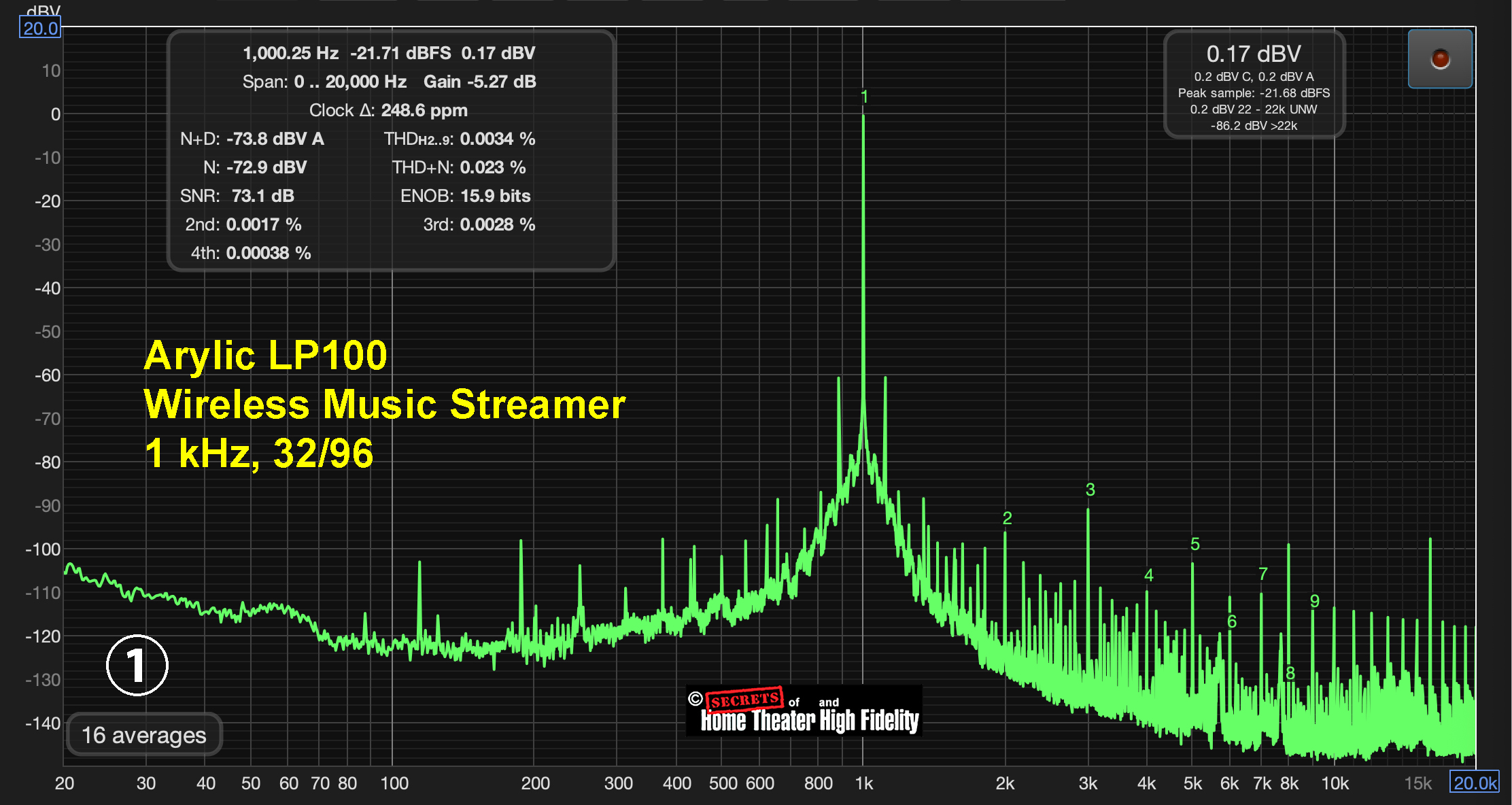
The first thing to notice (Figure 1, below) is that the SNR is only -73 dB (its spec is -80 dB). Even though I ran this test at 32/96, the ENOB (Effective Number of Bits) is 16. You can see the noise peaks in between the harmonic distortion peaks. However, THD+N is 0.023% which is not bad. So, for your $399, what you give up is low noise. However, as I mentioned in the previous section, I could not hear any background hiss at all, and I was listening with headphones. Note that for this particular test, I used a 20 kHz low-pass filter to show the distortion in the audible band.
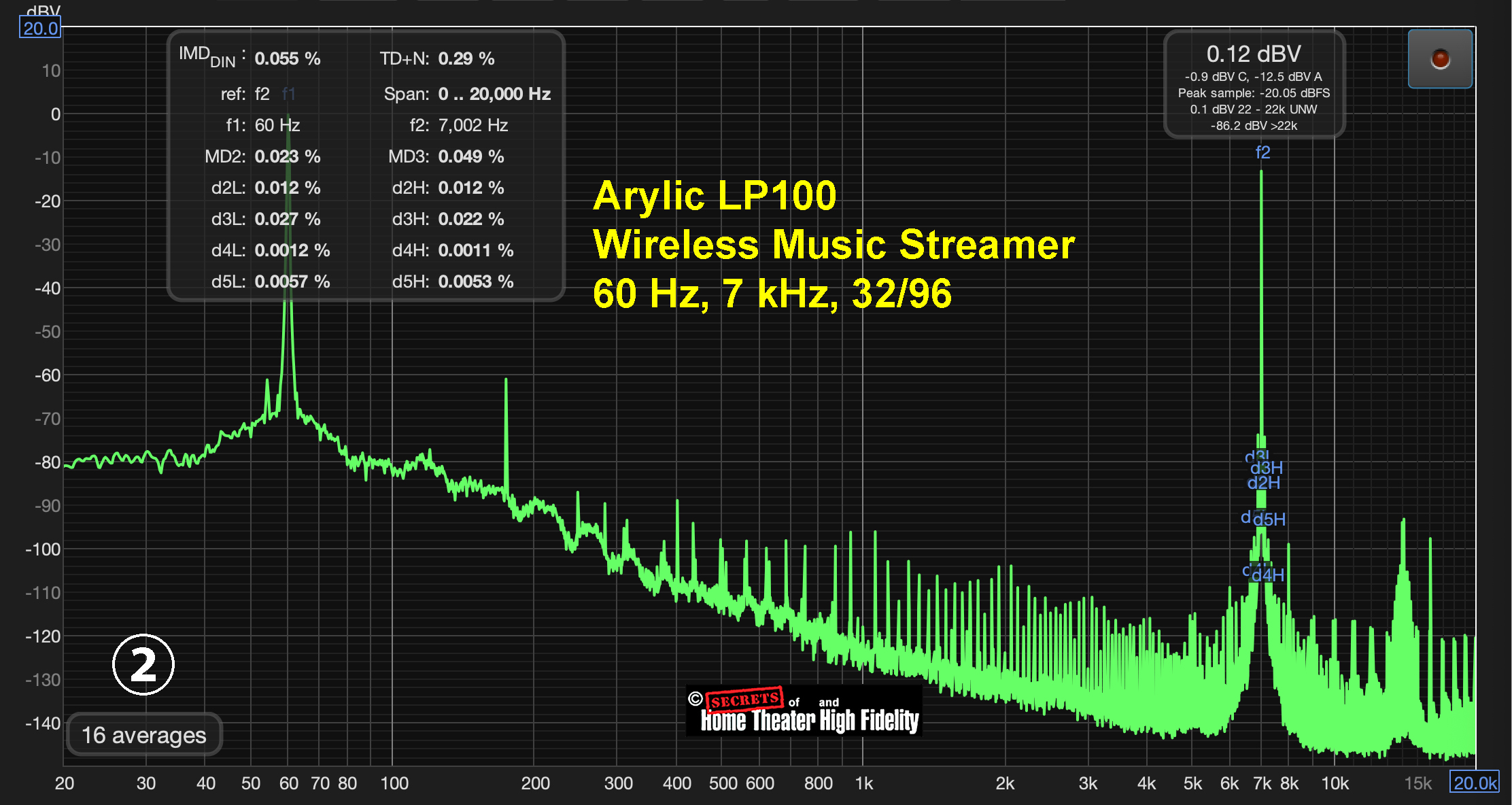
IMD (60 Hz, 7 kHz) is shown in Figure 2. It is 0.055%. An audiophile-grade DAC would likely have harmonic and intermodulation distortion 2 orders of magnitude lower than this (Figs. 1 and 2).
In Figure 3, the data from Figure 2 are shown with an expanded X axis.
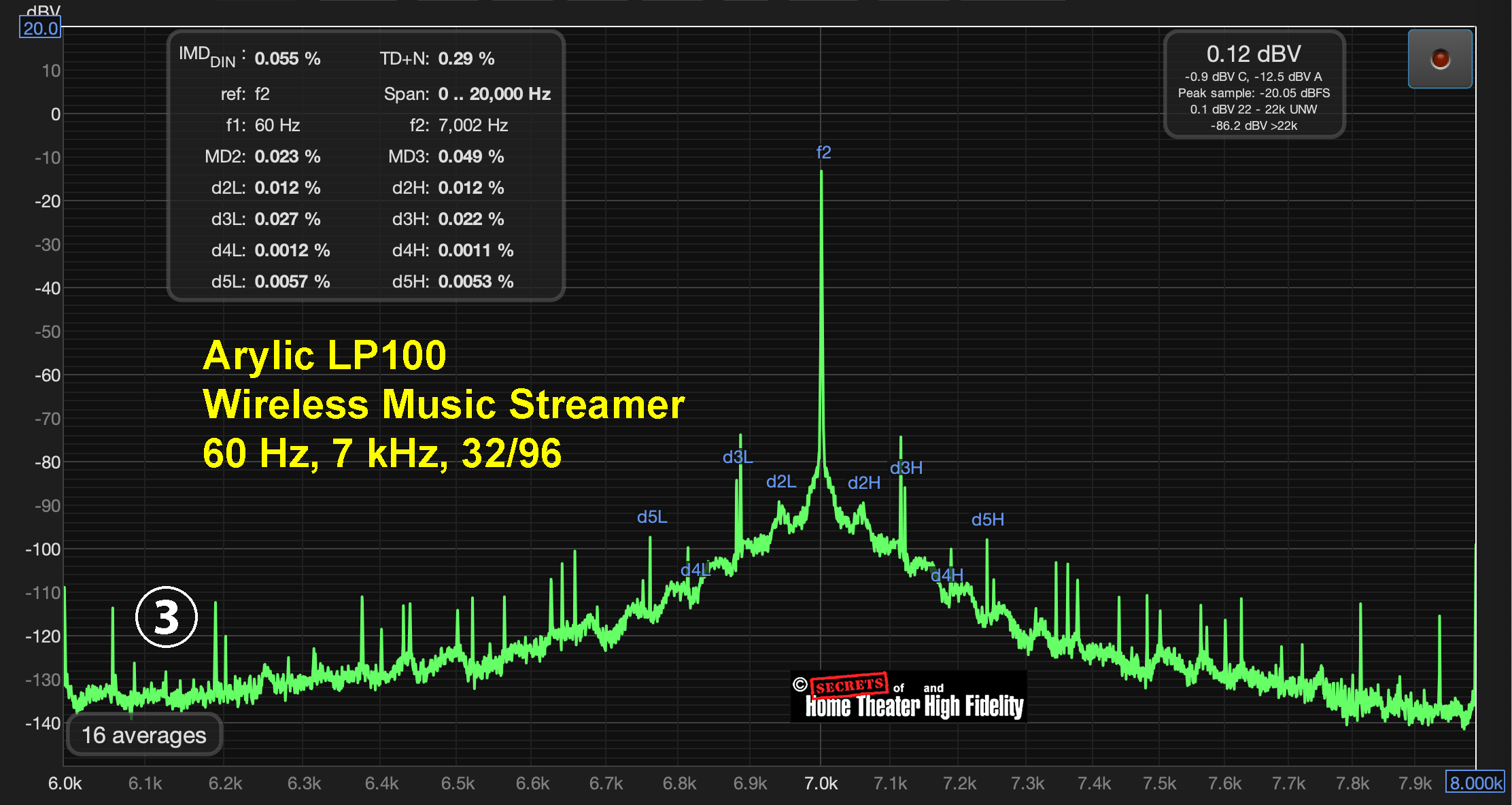
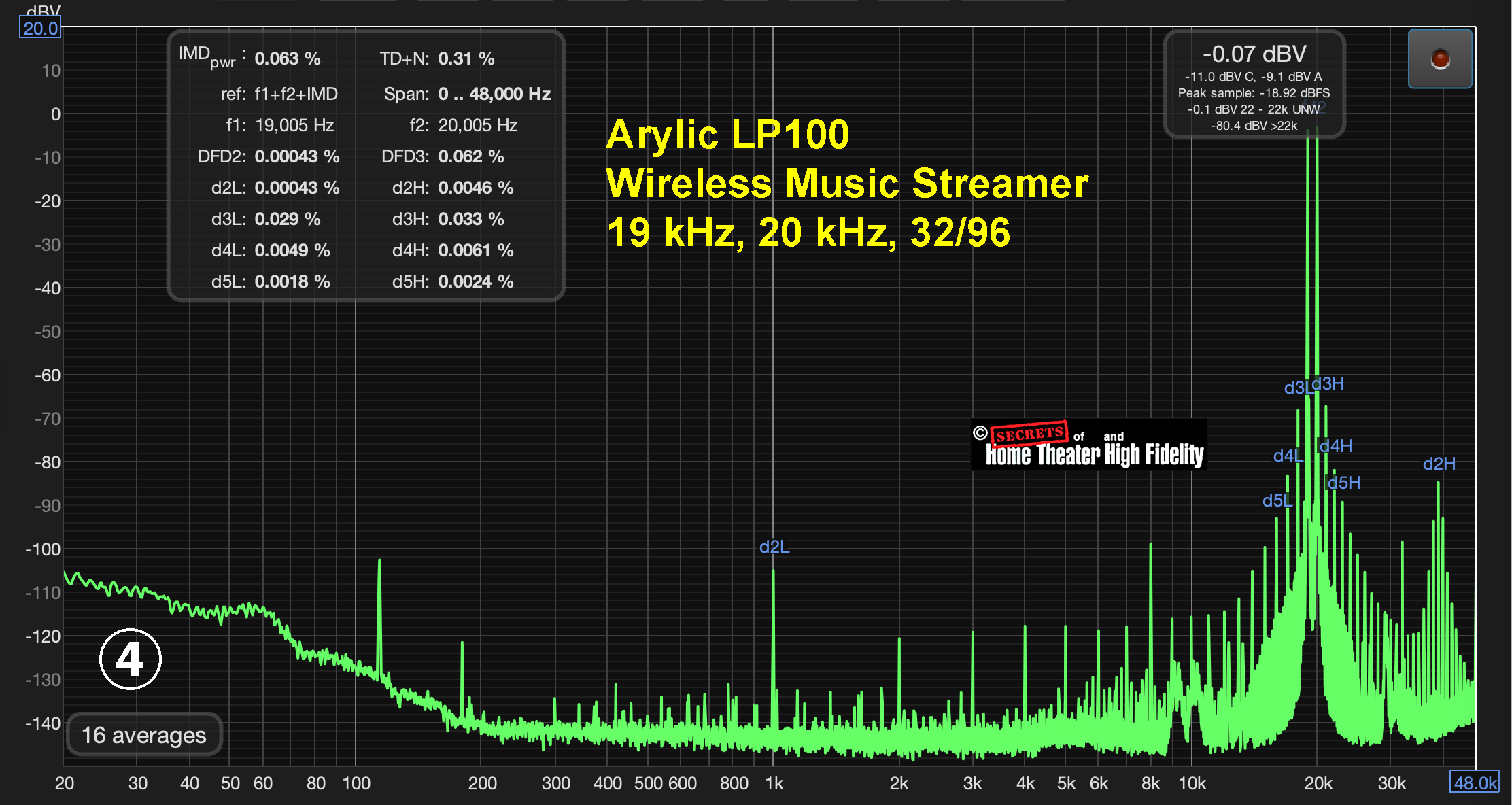
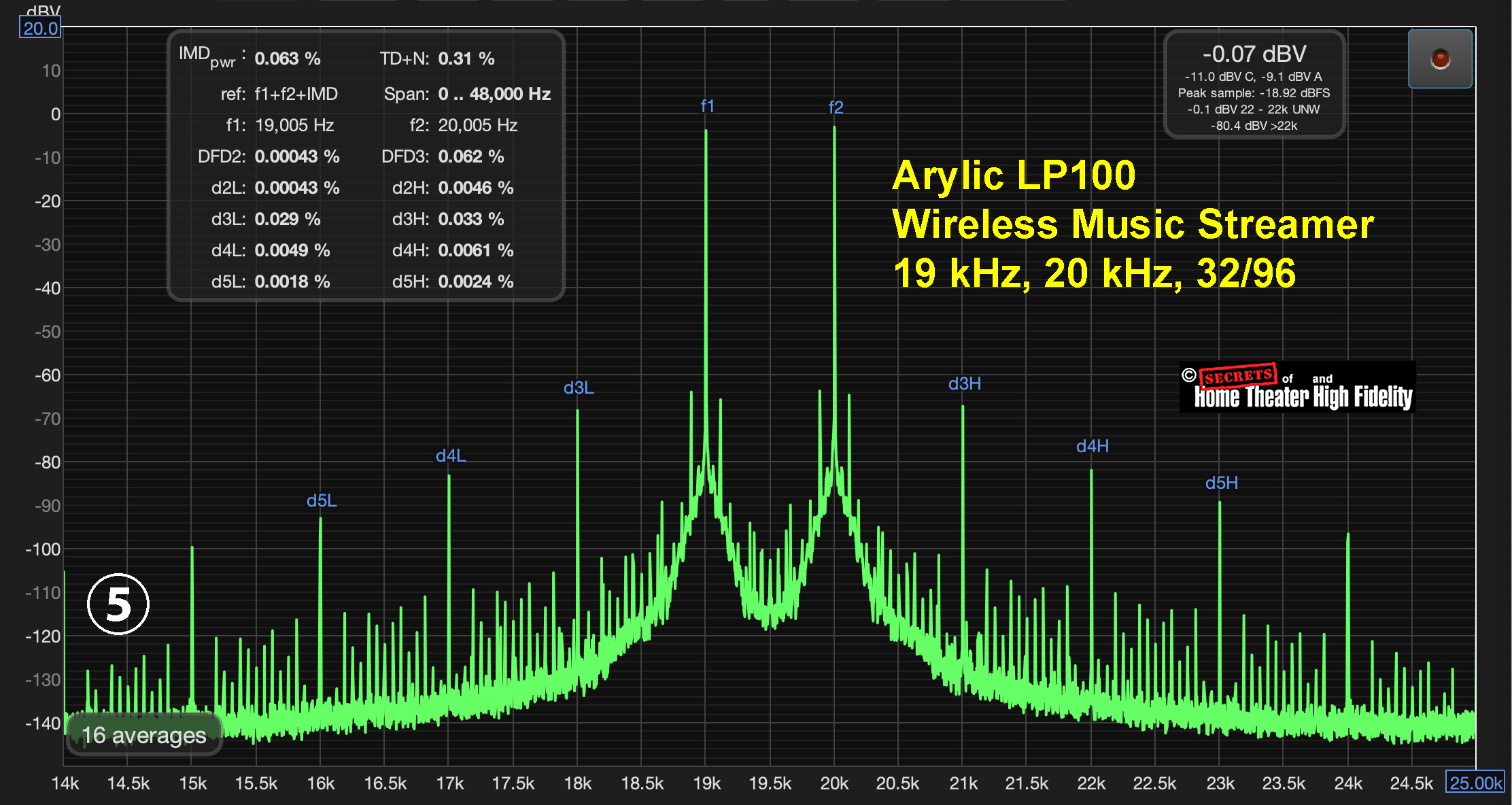
Figure 4, below, shows IM with 19 kHz and 20 kHz test signals. An expanded X axis is shown in Figure 5. This is a significant amount of distortion. It came through as slightly emphasized sibilance. It was not objectionable, though.
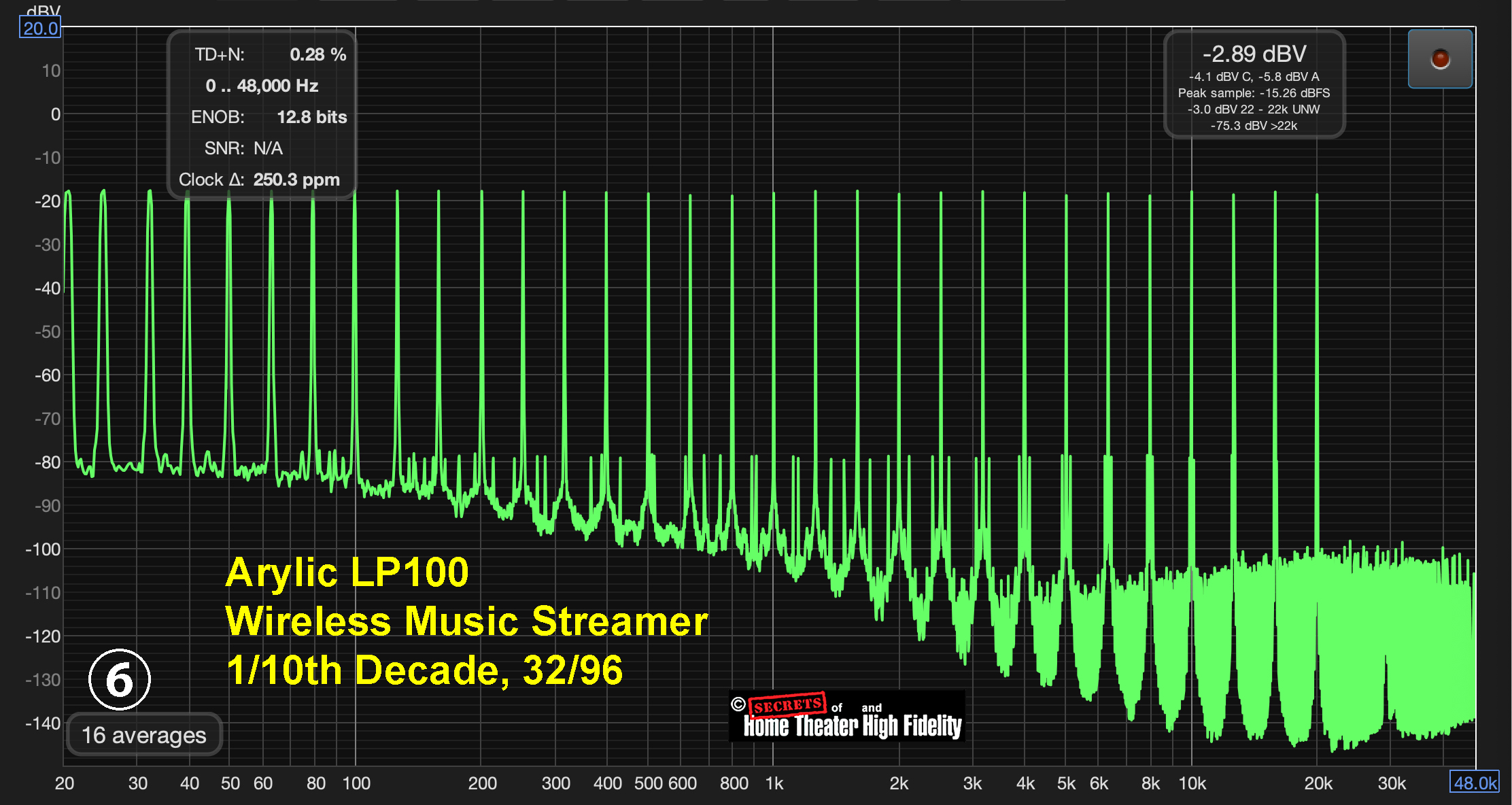
In Figure 6, a 1/10th decade set of sine waves is shown. This is a stress test to show where distortion is concentrated, which in this case, appears to be above 3 kHz.
The frequency response is shown in Figure 7 below. It rolls off sharply at 20 kHz for 44.1 kHz sampling, and slowly for 96 kHz and 192 kHz sampling.
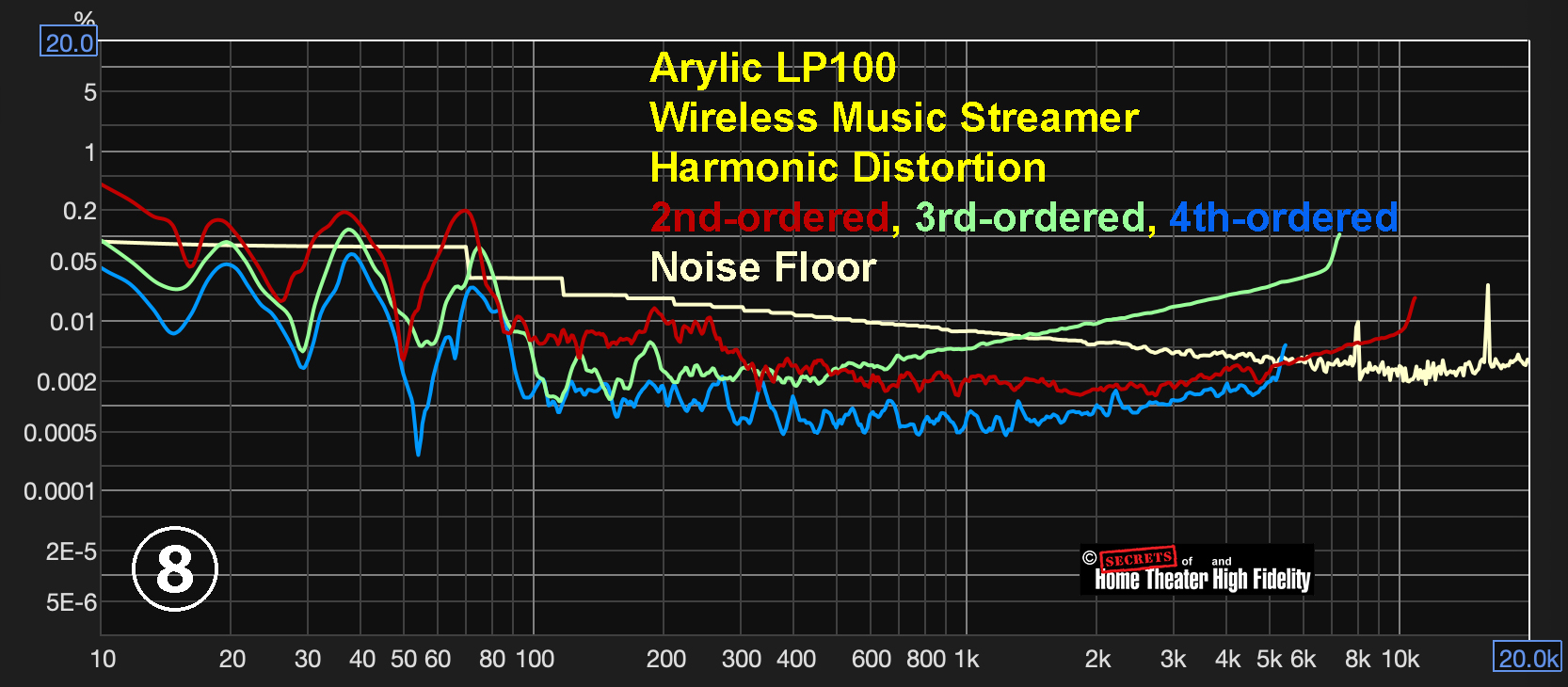
In Figure 8, below, you can see that the 2nd-ordered harmonic is prevalent between 10 Hz – 400 Hz, and then the 3rd-ordered harmonic takes over above that. The noise floor covers the distortion peaks for much of the audible range.
Secrets Sponsor
For $399, you get a lot with this DAC. It isn’t intended to be the center of an audiophile system, but rather the keystone audio center on a student’s desk.
For $399, the Arylic LP100 delivers an impressive amount of functionality, connectivity, and everyday usability. It is not positioned as an audiophile-grade DAC, and the bench tests confirm that its noise floor and distortion levels fall short of what a true high-end converter would offer. Yet in practical listening, the LP100 performs far better than its measurements might suggest. Across a wide range of music—harpsichord, vocals, jazz saxophone, piano, and electric bass—the LP100 remained clean, engaging, and entirely enjoyable. Even though revealing planar-magnetic headphones, it never drew attention to itself with audible hiss or obvious artifacts.
Where the LP100 truly earns its keep is in its versatility. With Wi-Fi streaming, Bluetooth (including LDAC), AirPlay 2, Chromecast, Tidal Connect, Spotify Connect, Roon-ready, USB-A/B playback, optical and coaxial I/O, HDMI eARC, line and phono inputs, subwoofer out, trigger out, app control, and a remote, it is astonishing how much capability is packed into a compact device at this price. For students, desktop listeners, secondary systems, or anyone building an affordable multi-source hub, the LP100 offers far more than its modest cost suggests. It may not be the heart of a purist audiophile rig, but as a flexible, feature-rich streaming DAC that consistently delivers pleasant, musical sound, it represents excellent value.