
|
|||||||||
|
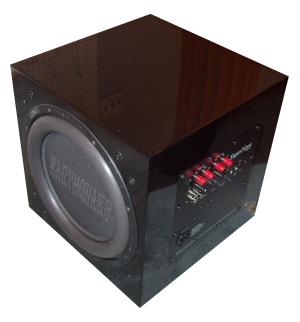
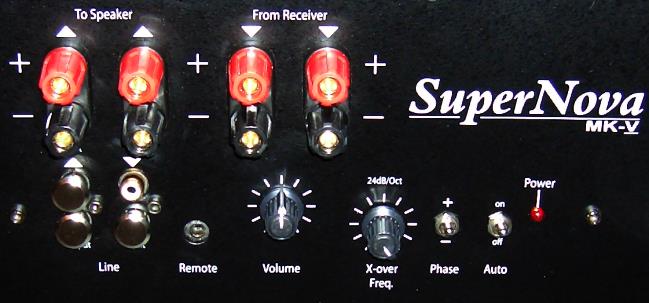
Introduction I have been wanting to review an Earthquake Subwoofer ever since I saw someone standing on one at CES, getting an 18 Hz massage. Not only was he shaking, but everyone's clothing nearby. I suppose the adjacent booths didn't like it, but I know all the passersby did. Joseph Sahyoun and John Paul Lefebvre dropped a SuperNova MK-V (the previous version was the MK-IV) off at our test facility last month for me to try out. It is big and heavy, as all good subwoofers are. In this case, all 88 pounds of it, with two 15" drivers (one active, one passive) and a 580 watt digital amplifier. The Design The SuperNova has an enclosure a few inches bigger than the driver, which Earthquake calls the "Magma-15". This driver is capable of ± 0.5" excursion, which means it can move a lot of air. A passive radiator, the SLAPS-15 (Symmetrically Loaded Audio Passive System) is mounted on the opposite side of the enclosure. This passive radiator is a very clever design, in that it has two passive membranes mounted facing one another, rubber surround and all. This is sort of a push-pull arrangement, which helps to reduce non-linear movement of the radiator. A 580 watt digital amplifier powers the SuperNova. It has line-level inputs and outputs, speaker-level inputs and outputs, a remote control jack, volume control, adjustable low-pass (X-Over Freq), phase switch, and auto/on. The X-Over Frequency control does not have markings for specific frequencies, which is a bit inconvenient.
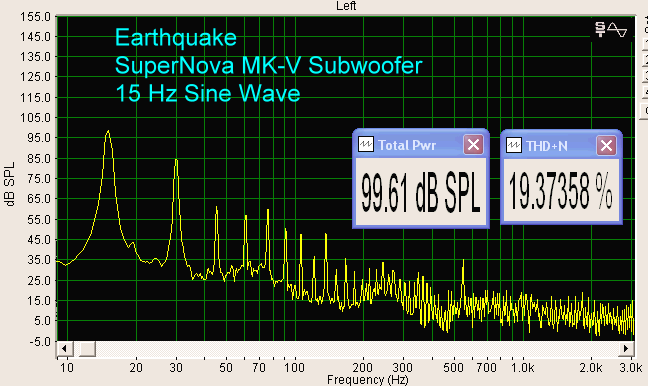
In the photo above, you can see I have covered three of the RCA jacks with Cardas Caps. These caps will reduce RF that can get into the amplifier circuit through input jacks. They go on whatever unused RCA jacks you have in your components. The SuperNova comes with a remote control for adjusting volume. An RF sensor with a cable that plugs into the remote jack on the back of the subwoofer is also included. The Listening I tested the SuperNova with a Classé SACD-2 Player, Yamaha Universal Player, Lexicon MC-12 SSP, Balanced Audio Technology VK-5i preamplifier, Balanced Audio Technology VK-500 Power Amplifier, McIntosh MC-602 Power Amplifier, McIntosh MC-1200 Power Amplifier, Carver Platinum Ribbon Speakers, and Thiel CS2.4 Speakers. Cables were Nordost and BetterCables. We have a pretty big listening space in the lab, and plenty of wall and corner treatments, but the MK-V managed to fill it to the brim with thunderous sound. From Tchaikovsky's 1812 Overture, to Stravinsky's The Firebird, there was nothing that made the SuperNova flinch. There is nothing like a big high-excursion driver coupled with lots of watts. With music, it is easier to detect harmonics, because it makes instruments such as string bass sound abnormal. However, I could detect no harmonics even at high listening levels. With movies, ah what a sound! From Matrix: Revolutions, to Pearl Harbor, the room shuddered with wonderful deep bass. Although one SuperNova is plenty, there is still some advantage to having stereo subs. Not all SSPs have stereo subwoofer outputs, but some do, such as the Lexicon MC-12 and Theta Casablanca III. The Burl Wood SuperNova is beautiful, but very expensive. So, if I were populating my system with the SuperNova, I would get two of the Black Polyurethane versions, which together are almost the same price as one Burl Wood version. On the Bench THD measurements were made with our calibrated microphone placed 15" from the active driver. I was able to achieve a maximum SPL of 120 dB at 1 meter, using a combination of 20 Hz, 31.5 Hz, and 50 Hz sine waves. At 15 Hz, THD+N was almost 20%. Part of the reason for this, is that the passive radiator is doing most of the work below 20 Hz. The active driver has an Fs (free air resonance) of 26 Hz.
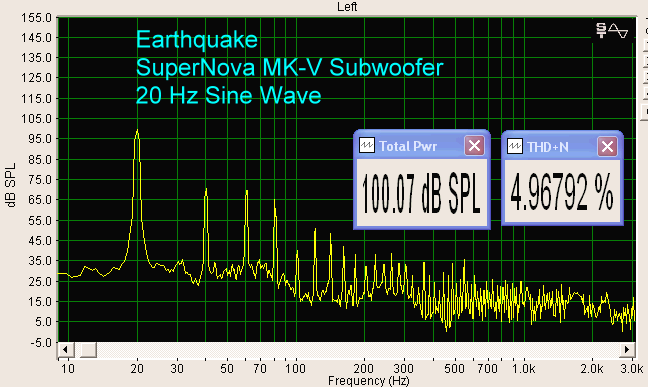
At 20 Hz, however, THD+N was reduced to less than 5%. This is very good for 100 dB output.
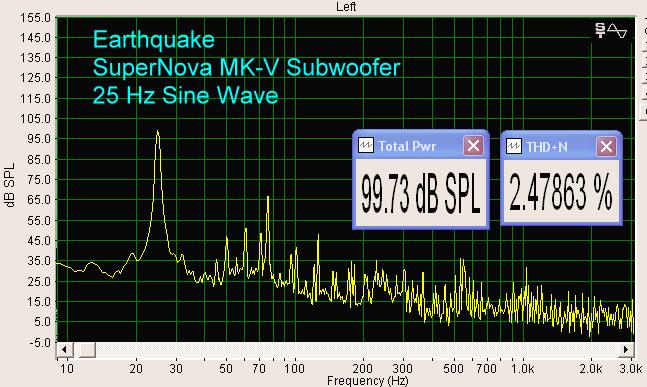
At 25 Hz, THD+N was now down to less than 2.5%, a superb number for such high output.
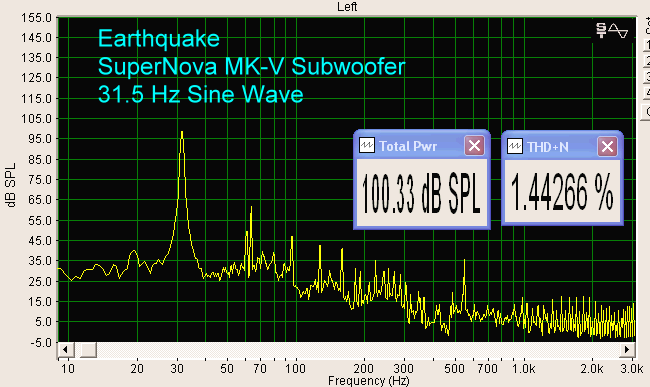
Again, an excellent test result at 31.5 Hz.
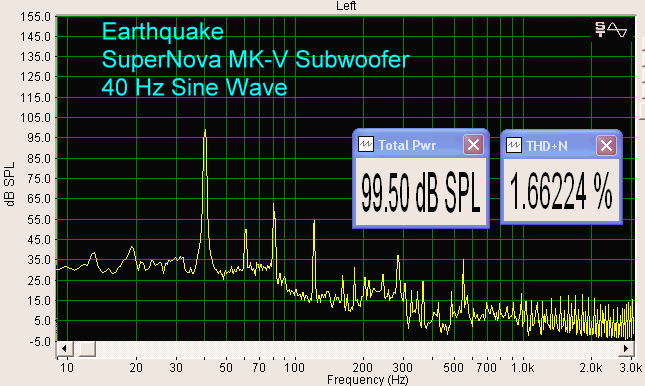
At 40 Hz, less than 2% THD+N.
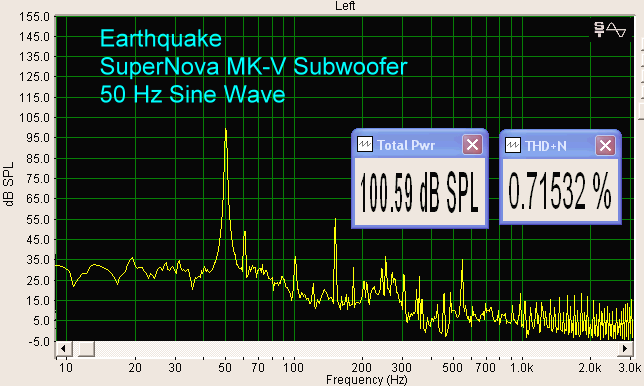
And at 50 Hz, less than 1%. Excellent!
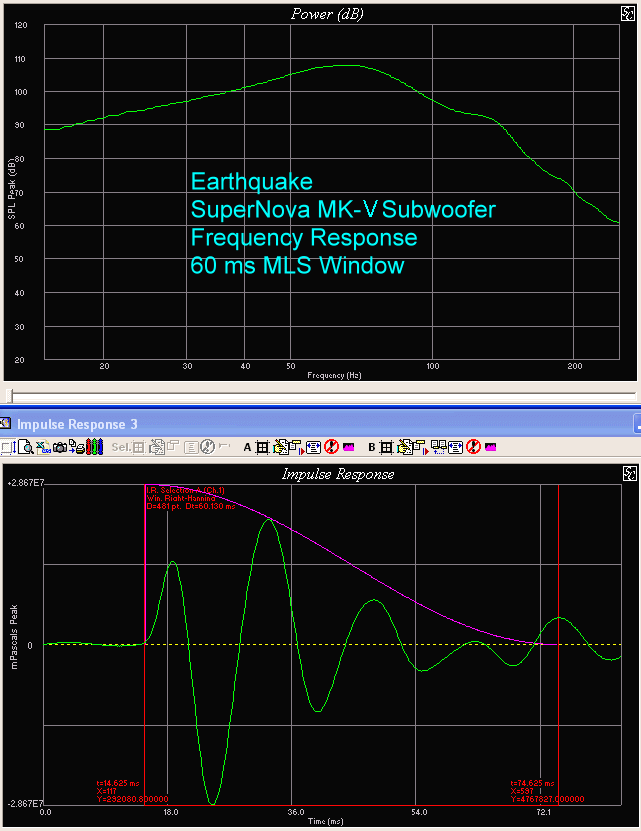
The quasi-anechoic frequency response is shown below. From 50 Hz to 20 Hz, the response is down 12 dB. This is a very good result. The impulse response is shown in the second graph. I used the SuperNova with the phase switch set to +. You can see that the initial wave swings positive. I have seen criticisms of the SuperNova because of its not having a continuously variable phase dial. However, with such a control, the phase is only set correctly at one frequency. At the rest of the frequencies, there is phase shift. So, in light of the new digital EQ units that are becoming available, which won't induce phase shift, a 00/1800 toggle on the SuperNova is fine.
Conclusions I guess it was worth the wait for an Earthquake SuperNova MK-V, because I loved it. This subwoofer plays loud, deep, and clean. It's reasonably priced if you get the polyurethane finish. You can't ask for anything more than that.

|
|||||||||





 YouTube
 Facebook
 Twitter
 LinkedIn
 Pinterest
 Google+
 Instagram
Magazine Publishing Solutions by
 Advontemedia