
|
||||||||||||||||||||||||||||||
|
Introduction The one encompassing statement accepted by all when starting into the world of high end audio is, “The loudspeaker is the most important and most influential part of the entire system.” A good loudspeaker can make medium grade electronics sound astonishing, but even the best components cannot make an inferior loudspeaker sound acceptable.
The overall voice of your entire system will be realized by your loudspeakers.
When people start into the market, they may know this and spend time and
energy getting the right speakers for their setup. However, once we get into
the perpetual upgrade loop, the speakers are often the first component to be
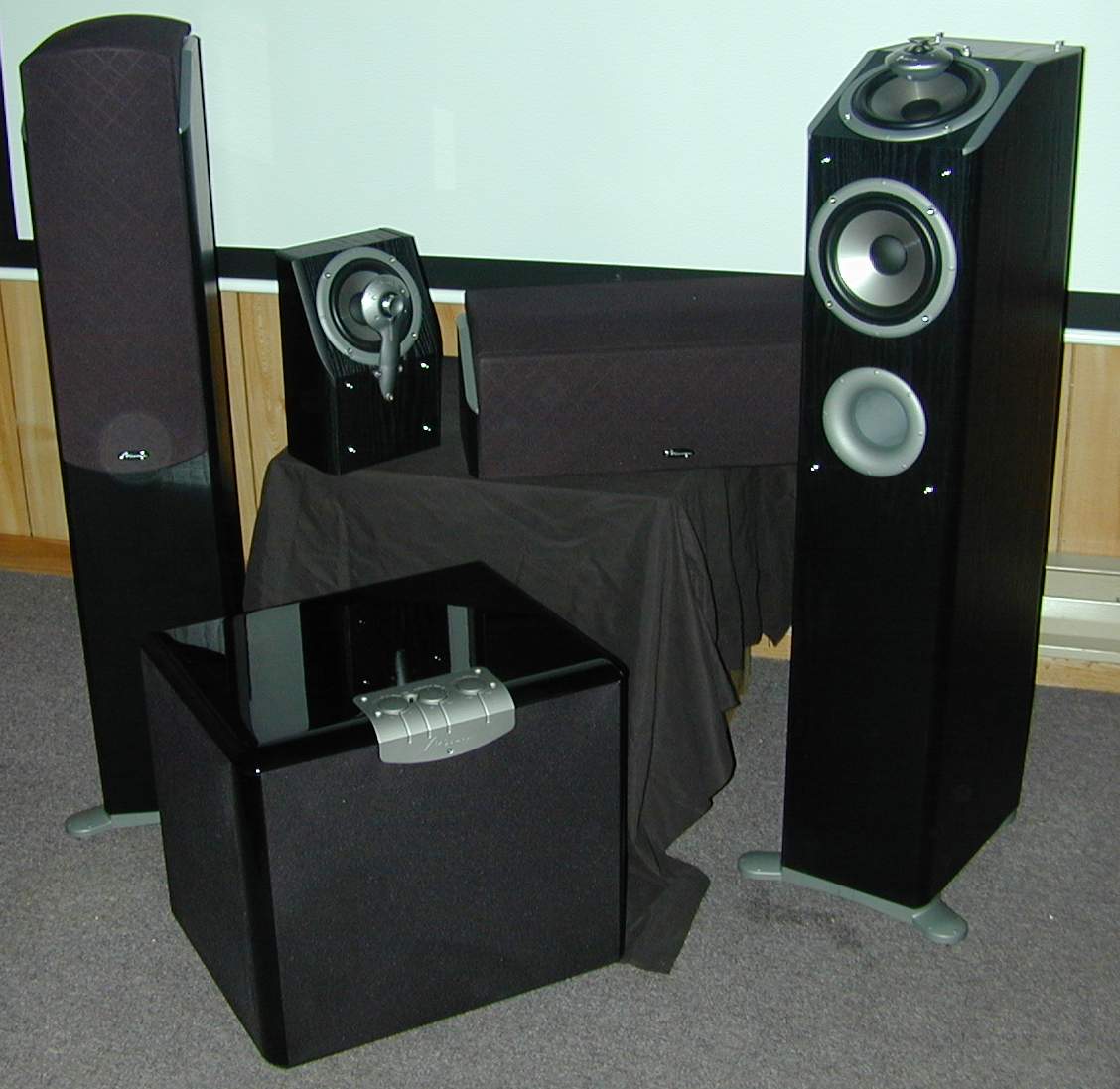
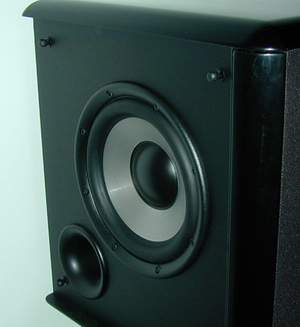
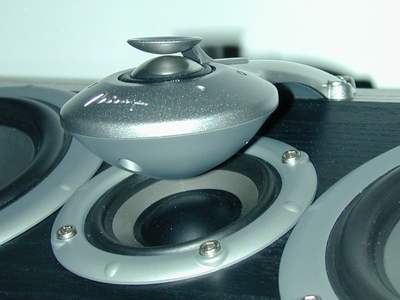
forgotten. The legacy of the Mirage OMNI polar speaker is a long one that started over 15 years ago. The flagship of the original series labeled the M1 débuted in 1987 and is still regarded as one of the best bipolar implementation to date. This was a massive speaker that weighed in at almost 200 pounds, and its legacy is still remembered in the hi-fi world. In the used market, which has a tendency to put prices on a more level playing field, the M1 is still a $1000+ speaker some 15 years later. That alone should validate the technology for most of us, but Mirage did not relax, and they continued to improve on their technology. In 1996, Mirage introduced the OM series of speakers which brought the technology and the listening experience to a new level with a bipolar design in a narrow column. This new design was the first in the OMNI polar family. I still own the OM-6, the original flagship of that series, and while many speakers have passed though my system, no speaker has been able to replace it. Like the original series it was expensive to build. It required twice as many drivers and more cabinetry work then their competitions conventional loudspeakers. That did not hinder Mirage's progress, and consumers were willing to pay higher prices for the benefits of OMNI polar sound. But, Mirage still believed there was a bigger market opportunity if they could find a way to reduce the cost of the OM series. The OMNI series being reviewed here is Mirage's first attempt at such a system and will replace Mirage's more conventional FRx series. Lets see how they did it . . . . The Mirage OMNI Series To achieve the same dispersion pattern as the OM series, Mirage did the most logical thing they could do, flip the drivers on end and point them straight up in the air. Since sound waves are dispersed similar to throwing a stone in a puddle, this driver orientation would give the closest pattern to a pair of speakers mounted in Mirage's OMNI polar configuration. Now any reputable speaker manufacture knows you cannot listen to a driver in this orientation. Just look at the polar plot of any driver's frequency response when you get more than 300 off axis, let alone 900. However, that was no reason to give up. Instead, Mirage's research department tilted the mid-bass drivers slightly forward and designed a tweeter raised outside of its mounting basket. The tweeter and mid-bass drivers can then be placed in very close proximity to one another. Mirage then uses the bottom of the tweeter housing and a small elevated hat over the tweeter to aid in the dispersion pattern. This new combination gives an optimal off axis frequency response and mimics the dispersion pattern of the original OM series with the use of only two drivers. In my experience, this would be the closest representation of a point source using a mid-bass tweeter combination that exists today, which is a good thing. This new technology has been coined by Mirage as OMNIGUIDE. Of course, there is more to the research than what is explained here, and I have seriously oversimplified Mirage's process. My point is, this is a new concept, something I have not seen before. The question is . . . does it work? OMNI 260
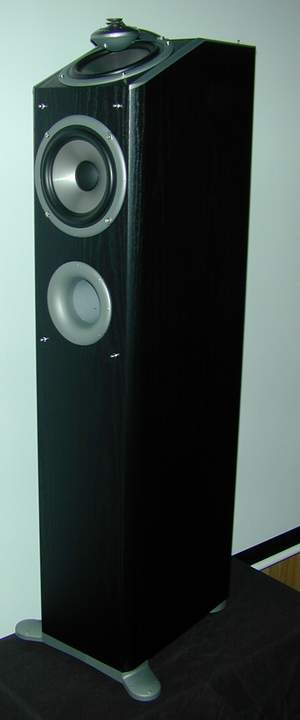
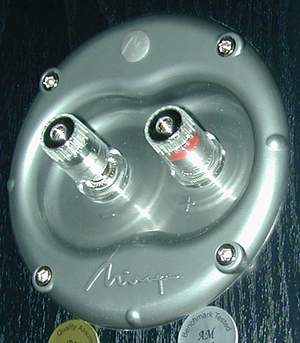
The first speakers people select when setting up any audio system, rather for music or home theater, are the mains. The OMNI 260s are the flagship of the OMNI series but are not flagship in price. They list at only $500 each or $1,000 for the pair. The 260s are shielded and feature the OMNIGUIDE technology. The driver composition is made up of a shielded quasi-three way design. The OMNIGUIDE portion consists of a 1” PTH (Pure Titanium Hybrid) tweeter, suspended over a 6 1/2” titanium deposit mid-bass driver. The bottom of the frequency range is augmented by another 6 1/2” titanium deposit driver and a flared port achieving a 3 dB down point of 35 Hz. The cabinets are constructed of 3/4” MDF and covered in Black Ash or Cherry. You will not find bi-wire binding posts on any of the new OMNI series. There are people that believe bi-wire enhances the listening experience, but I have never shared that opinion. In fact, if you spend a day with Secret's Colin Miller you would probably never bi-wire a speaker again. My personal belief is the difference is negligible. With the savings Mirage made by using only a single set of posts, they arguably installed the nicest binding posts I have ever experienced from a usability perspective (photograph near bottom of this article). They are standard metal with clear plastic coverings mounted on a custom plastic mount. While that sounds simple, the key is they are large, easily graspable, and positioned such that they are easy to get at. I use bare wire in my home theater, as I have not gotten around to purchasing spades or bananas. Most binding posts leave nasty impressions in my fingers caused by tightening them down. No such problems occur with the new Mirage posts. They would easily accept 10 gauge speaker wire, but if you are going to use spades, choose fairly wide ones, as the post centers are wide themselves. The 260s have feet which stick out of the sides of the speaker on a front-facing 300 angle to ensure stability. They remind me of duck feet and take some time to get used to, but I have grown to like them. They can accommodate spikes of rubber feet and give the speakers a sturdy stance. Due to the design of the OMNIGUIDE, it was also necessary to design a new kind of speaker grille. The grilles on the 260 are a two- piece design. The first part sits on top of the speaker covering the OMNIGUIDE and is attached with rubber mounts under the grilles, fitted over metal pins on the speaker. The second grille covers the front of the speaker in a similar fashion. The design works well and discourages my wife from setting household trinkets and pictures on top of the speakers.
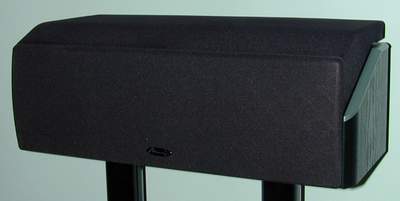
OMNI CC The center channel is arguably the most important speaker in our home theater and multi-channel music setups. The OMNI CC consists of the same OMNIGIUDE technology used in the 260s but in a different configuration. The driver components consist of the OMNIGUIDE 1” PTH-pure titanium hybrid tweeter suspended over a 3” midrange, complemented by two 4 1/2” titanium deposit hybrid woofers. This is all sitting on top of a sloped platform. The speaker is a ported design, constructed of 5/8” MDF and finished in the same fashion as the 260s. The grille design and binding posts are also shared with the 260s. The OMNI CC is timber matched to work with any of the speakers in the Mirage lineup and lists for $400. With the CC starting to roll off at 50 Hz, you will still want to set it up as "Small" in your SSP or receiver.
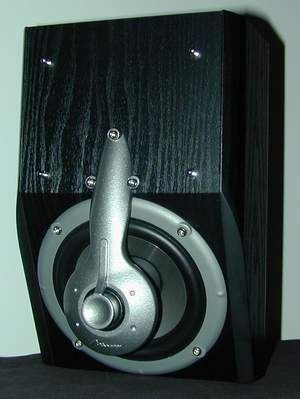
OMNI FX There are two camps when it comes to rear channel surrounds. Some people prefer traditional direct radiators, while other favor a more diffuse dipole design. Even within the Secrets writing staff there are differences of opinion. I have always preferred dipoles, but I believe the reason is years ago I upgraded from some poor direct radiators to some high quality dipoles. Mirage classes the OMNI FX as an OMNI polar speaker and do not suggest it belongs in either camp. Instead they claim ,and I quote, "Fewer speaker placement headaches arise with the use of the OMNI FX surround speaker, as the resulting sound is spacious and not easily localized, perfect for creating sound effects like a helicopter flying in the background or rainfall falling around you." I will talk about my experiences and opinions on this a little later in the article. The OMNI FX speakers are constructed from 5/8” MDF and can be finished in black or white to match your décor. A single grille covers the OMNIGUIDE in a single encompassing arc. The OMNI FX speakers are sold as single units for around $200 to allow for easy setup of 5.1 to 7.1 systems. Mounting is accomplished by connecting OMNI FX to an included bracket with the aid of a very heavy metal bolt connected to the top of the binding post cup. The speaker is stabilized by two thick rubber feet which should be attached to the back of the speaker. I would have known this had I read the instructions, but due to my dislike for instruction manuals, I stuck the rubber feet to the wall, oops . . . . Mirage quotes the frequency response of the FX to be 80 Hz to 20 kHz at ± 3 dB. This response will work well with THX or other SSPs that use 80Hz as their crossover point. I do not have the tools necessary to measure these so I cannot verify the response. I can say I did not notice any issues during numerous listening sessions.
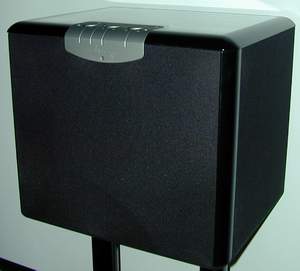
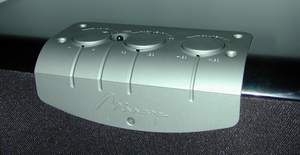
OM-200 The OM-200 subwoofer is what started the quest for this review. At CES, a group of us spoke with Mirage to see what the deal was with all the cool looking speakers (the new OMNI series you are reading about here). They, of course, explained all the benefits of the 3600 dispersion pattern at lower costs and even introduced us to one of the designers. As part of the discussion, they showed us a new matching sub, the OM-200. Their claims at the show were quite interesting, and included comments like more power; 6 dB more output than its predecessor and a 20 Hz 3 dB down point. Knowing the value of the BPS-150, this was an intriguing concept. We now know the new OM sub line is designed to replace the BPS lineup, and if the OM-200 is the baby of the group, then Mirage's competition should be paying attention. The OM-200 consists of two 8” Titanium Deposit-Polypropylene Hybrid woofers with 28 oz magnet structures and 1.5” voice coils, small on the outside, big on the inside. It sports a 200 watt amp (with claims of 800 watts peak) and all the typical controls and adjustments you would find on a subwoofer, such as auto on/off, level control, variable phase and crossover. Mirage did not stop with the typical, because they also included a video enhancement mode (+3 dB @ 40 Hz) for those who want a little more kick with their movies. There is also clipping and thermal protection, a variety of inputs, and some pretty hefty rubber feet and spikes.
For inputs, Mirage has given the user lots of choice. First, there are speaker level inputs and outputs for use in a stereo setup. Second, there is a standard low level input which utilizes the subwoofer controls, and finally another low level input which bypasses the controls except for phase. This last input is the one to use with most SSPs and receivers. General Comments With the OMNI series replacing Mirage's existing FRx lineup, it is appropriate to make some comparisons. The new OMNI 260 lacks the powered subs and lower frequency extension of the FRx-9, but makes up for it by being $200 cheaper. On the lower end of the scale, the smallest OMNI speakers, the OMNI 50s, are $150 more than the FRx-one. To address this, Mirage has released a couple of smaller and cheaper offerings in the OMNISAT series. Mirage has kept a speaker for everyone's price point. The design and finish of the OMNI lineup is excellent and betters the FRx series. I also believe Mirage has improved on the audio performance of the FRx series, and I will talk about that below. Sound I have been using the OMNI series for a couple of months in my home theater which doubles as a multi-channel music system. During that time, countless CD and DVDs have traversed the system from two-channel audio like EMINEM and Diana Krall, DVD-Audio from the Corrs to Queensryche and movies from The Ring to Harry Potter. The OMNI setup is a flexible system and works well with all the material I put through it. As with all of Mirage's OMNI polar speakers, the sweet spot is one of the largest in the industry. Sitting off center by a couple of feet will not hurt the perception of image or soundstage. This adds value when you have multiple people in the room, but as with all speakers, there is still that 1 cubic foot spot where it is almost magical. With the OMNI setup, that spot can send chills down your spine as two-channel music surrounds you, and you have to check to make sure the processor is not in some sort of DSP mode.
As with the earlier OM series, the OMNI series is somewhat sensitive to placement. Some people believe these speakers have a huge soundstage, but do not image as well as a conventional design. Living with the OM series for several years, I have grown to disagree with that statement. Instead, I tell people it all depends on placement. With the OMNI series, a very similar statement can be made. First off, these speakers like some room to breathe, so place them a foot or two away from the walls. Next, you will want to make a decision about toe in, as there are some tradeoffs to be made. If you want pinpoint imaging, use lots of toe in and point the speakers such that they are facing the listener. This will collapse the width of the sound stage slightly and make the sweet spot smaller, but the pinpoint imaging is amazing, easily as good as any other speaker I have used. If you want a huge enveloping soundstage, then place the speaker without any toe in. I use just a small amount of toe in which gives me the best of both worlds. The OMNI speakers are capable of producing a truly three-dimensional soundstage. I have never experienced a speaker in a two-channel audio setup that was capable of creating images behind the listener. The original OM series were always capable of producing images to the sides of the listener on certain tracks but never behind. To be truthful the OMNI 260s were a holographic experience. I had to check 3 times (seriously 3 times) to make sure the processor was not in some sort of surround mode. I even got up out of my chair and put my ear against the surround speaker just to verify one last time. I was of course sitting in that perfect sweet spot and it does not happen with all recordings, but when it does, it is a real pleasure. The OMNI 260s are very natural speakers and do not appear warm or bright in presentation. I would recommend using a subwoofer for home theater applications, because, like most floor-standers, they just don't have the lower frequency extension required to get the most out of a good movie soundtrack. The benefits of a timbre matched speaker setup in home theater or multi-channel music had been discussed here before, so I will save you the details. In panning around the room with pink noise, the setup is well matched. There is some minor tonal difference between each speaker, but I have yet to hear a 5.1 setup that did not exhibit this. In most rooms even different speaker positions will cause tonal changes. The biggest problem I have setting up a 5.1 system is with center channel placement. I can never have it at the same level as my main speakers, as the display device is in the way. My home theater with a 60”x80” screen is the worst case. I set up the OMNI CC on a stand below my screen which places it no more than 1 1/2 feet off the floor. This is not optimal placement, but is the only option in my setup. Using the CC was a real treat, as most of the problems with speaker placement went away. The image from the CC appeared about midway up the screen, right where it should and sounded as natural as any conventional center. Transitions of sound across the front of the room were smooth and did not experience the drop in placement as with my previously center. So as you can imagine, I am happy with this speaker, and OMNI polar comes through again. In my setup, the OMNI CC is a warm sounding speaker, certainly warmer than the OMNI 260s. This is caused by the lower positioning of the speaker. If the speaker is positioned at the same level as the mains, it sounds almost identical.
Remember I said I would get back to making a decision if the FXs were more like dipoles or direct radiators? To be truthful, I still haven't made up my mind. They sound more direct than my OM-R2s which are bipoles, but the FXs still do not sound as direct as many home theaters I have heard with directs as rears. Since Mirage claims they are neither, I guess I should just leave it at that. Regardless, they do a great job from pans of helicopters around the room off the THX sampler DVD, to the rain in the opening scene of "Seven". The OM-200 maintains Mirage's excellence in subwoofer design and hold up to its claims of bettering the already successful BPS-150. The bass is tight, controlled, and blends well for both music and movies. I am amazed by the performance achieved by the little cabinet sitting between my center and the right main speaker. It easily holds up to the task of my 12x24 foot room. While I do not use the entire room for my home theater, the sub still has to fill it with sound. The little dual 8” sub never faltered once during real listening tests or even the most involved action sequences. Sure, I could push it beyond its limits, but I cannot imagine a user would find that point under normal circumstances. Remember, I said this little dual 8" sub was $1,000. The question is do the features and performance justify the price? Looking at the features alone, it has everything a $1,000 sub would have. The only feature it might be missing is a remote to adjust level, phase, and output from your seat, which adds little to no value after calibration. The sub easily gets down to 20 Hz and even a little lower in my room. It is a great looking compact design that your wife will allow in the room (priceless). So all-in-all I think it is worth $1,000 and chances are you will be able to purchase it slightly cheaper from a Mirage dealer, making it an even better buy. Conclusions
At the heart of the OMNI system is the new OMNIGUIDE design allowing for Mirage's acclaimed OMNI Polar sound from a single pair of drivers. My words to the designers are ‘bravo and congratulations'. The new OMNI series from Mirage is a technology to be reckoned with. Each part of this system deserves praise, and bringing the entire system together is like making a match made in heaven. If you are considering a new 5.1 setup or just a new set of mains or a sub, check these out, and you will not be disappointed. I have enjoyed my time with the new OMNI series so much I am considering moving my beloved OM-6s to my two-channel system and purchasing this setup for my home theater. While they are not the OM series, they are the next best thing, at a much lower price.
- Sandy Bird - Reviewers Equipment:
System 1:
|
||||||||||||||||||||||||||||||





 YouTube
 Facebook
 Twitter
 LinkedIn
 Pinterest
 Google+
 Instagram
Magazine Publishing Solutions by
 Advontemedia